
Table of Contents
Key Takeaways:
- The cost of building a fantasy sports app can start from $25,000 for an MVP version and go beyond $200,000 for a full-fledged app.
- You can calculate the budget with the formula. Total development cost = hourly developer’s rate * total development time.
- The factors affecting the fantasy sports app development cost are features set, app complexity, platform choice, UI/UX design, real-time sports data integrations, backend infrastructure, and hosting, etc.
- To optimize the cost to develop a fantasy sports app, begin with MVP, go cross-platform development, use pre-built integrations, an agile development approach, and prioritise features.
- The monetization models that affect the cost are entry fees, freemium + premium, in-app advertising, sponsored contests, and in-app purchases.
The cost to develop a fantasy sports app can range from $25,000 to over $200,000. That is a huge gap, and it usually leaves people more confused than informed.
The reason is simple. The final cost depends on what you build, which platforms you choose, and the team you hire. A small decision can push the budget up or down in a big way.
So, instead of chasing one fixed number, it makes more sense to understand what actually drives that cost. And that is important right now.
Fantasy sports have grown into a massive market with over 245 million users in 2025. Apps like DraftKings and FanDuel have already shown the profitable space, and new apps are entering the market every year. That’s exactly why knowing the cost becomes so vital.
When the opportunity is this huge, and if you make the wrong investment decision early can be expensive. Thus, if you are planning to build your own fantasy sports app, knowing the cost upfront can save you from costly mistakes later.
In this blog, we will break down the real cost of developing a fantasy sports app and describe what affects your budget the most.
So, let’s begin!
Quick Cost Snapshot: Fantasy Sports App Development Cost
The cost to develop a fantasy sports app typically ranges from $25,000 to $200,000. This can fluctuate depending on the app complexity and feature type. Let’s have a look at the table of custom cost to develop a fantasy sports app in 2026, broken down by app type.
| App Type | What It Included | Estimated Cost | Timeline |
| Basic or MVP version | User login, team creation, basic scoring, and leaderboard. | $25,000 – $50,000 | 2-3 months |
| Mid-level app | Real-time scores, multiple sports, push notifications, and a payment gateway. | $50,000 – $120,000 | 3-5 months |
| Full-fledged app | AI recommendation, live streaming, DFS, analytics dashboard, multi-sport. | $120,000 – $200,000+ | 5-8 months |
Note: If you hire a fully US-based mobile app development team, the cost can go higher. But if you work with a quality offshore or hybrid team, costs come down without sacrificing quality.
What is the Formula to Estimate the Cost to Develop a Fantasy Sports App?
The formula for estimating the cost to build a fantasy sports mobile app is provided below.
| Total Cost of building a Fantasy Sports App = Total Hours to Build × Developer’s Hourly Rate |
That’s it. This is just the simple formula. To figure out your budget, you need two things. One of how many hours it will take, and what your development team charges per hour.
How Hours Are Calculated:
Every screen, button, and feature has to be designed, coded, and tested. That all takes time. Let’s check out the hours breakdown for a mid-level fantasy sports app:
| Team Role | What They Do | Estimated Hours |
| UI/UX designer | Designs the app looks and feels | 150 – 200 hours |
| Frontend developer | Builds the screens and interactive features | 300 – 400 hours |
| Backend developer | Builds the server, database, and all app logic | 350 – 400 hours |
| QA tester | Tests every feature to catch bugs before users do | 150 – 200 hours |
| Project manager | Keeps the whole team on schedule | 100 – 150 hours |
| Total | 1,050 – 1,400 hours |
| Team location | Hourly rate | What they get |
| USA/Canada | $100 – $250 per hour | High quality, timezone convenience, high cost |
| Easter Europe | $40 – $100 per hour | Strong quality at a reasonable cost |
| Asia | $25 – $50 per hour | Great quality at a fraction of the price |
Quick Example: A mid-level application takes about 1200 hours. At $40 per hour from Asia, that is $48,000. However, at $150 per hour from the USA, that same app costs $180,000. Both have the same features but a very different bill. This is one of the biggest budget decisions you will make.
What Are the Factors that Affect the Cost to Build a Fantasy Sports App?
The major factors that influence the cost of developing a fantasy sports app are:
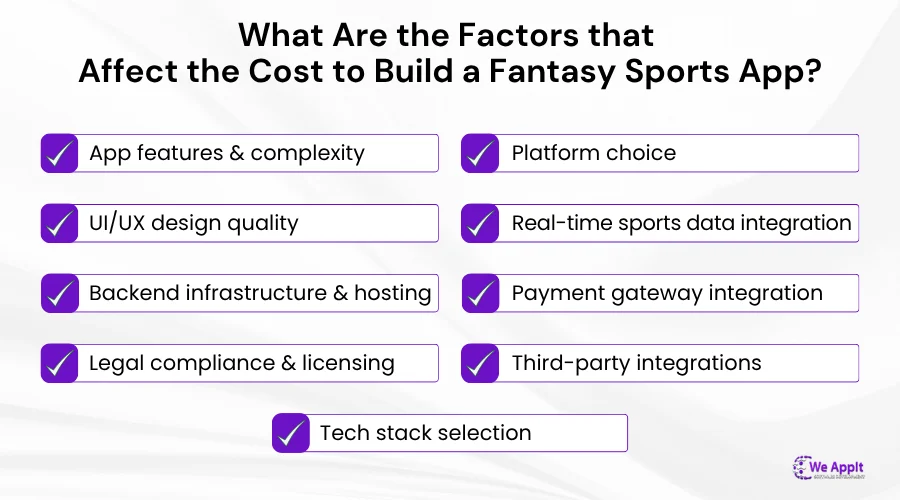
- App features & complexity
- Platform choice
- UI/UX design quality
- Real-time sports data integration
- Backend infrastructure & hosting
- Payment gateway integration
- Legal compliance & licensing
- Third-party integrations
- Tech stack selection
Knowing these factors can assist entrepreneurs or startup founders in planning a practical project budget. We will now take a deep look at the cost drivers for a fantasy app.
1. App Features and Complexity
This is the first cost driver. The more features you want, the more hours it takes, and the higher the development cost. The table below shows how features stack up on fantasy app tiers:
| Feature | Basic App | Mid-level App | Advanced App |
| User registration & login | ✅ | ✅ | ✅ |
| Social login (Google/Apple) | ❌ | ✅ | ✅ |
| Team creation & player selection | ✅ | ✅ | ✅ |
| Basic scoring system | ✅ | ✅ | ✅ |
| Real-time score updates | ❌ | ✅ | ✅ |
| Leaderboard | ✅ | ✅ | ✅ |
| Multiple contest types | ❌ | ✅ | ✅ |
| In-app payment gateway | ❌ | ✅ | ✅ |
| Push notifications | ❌ | ✅ | ✅ |
| Multiple sport support | ❌ | ✅ | ✅ |
| AI-based player selection | ❌ | ❌ | ✅ |
| Live analytics dashboard | ❌ | ❌ | ✅ |
| In-app chat/support | ❌ | ❌ | ✅ |
| Daily fantasy sports (DFS) | ❌ | ❌ | ✅ |
| Live streaming | ❌ | ❌ | ✅ |
The best move many successful founders make? They do not create everything at once and do not add all the features in the beginning.
They simply launch with the basics, get real users, get their feedback, and then add features. It saves you huge amounts of money and prevents you from creating things nobody actually uses.
2. Platform Choice: Android, iOS, or Both?
This is one of the first decisions you will make, and it directly impacts your budget.
| Platform | Pros | Cons | Cost Impact |
| Android Only | Wider global reach, easier app store approval | Misses iOS users who tend to spend more | Lower |
| iOS only | High-spending users, premium experience | Smaller total audience | Slightly higher |
| Both (Native) | Best performance on each platform | Two separate codebases = double the work | Highest |
| Cross-platform | One codebase works on both platforms | Slight performance trade-off | 30-40% cheaper than dual native |
For many USA-based startups, cross-platform is the right first call. You can build once, launch on both Android and iOS, and save a meaningful chunk of your budget. Flutter and React Native have gotten really good.
For most app features, users can barely tell the difference from a native app. You go native when you have 50,000 users and need that last 5% of performance, but not before.
3. UI/UX Design Quality
Some apps feel visually appealing, intuitive, and fun. However, other apps feel so clunky and confusing. That huge difference is design, and bad design is one of the top reasons users delete a fantasy sports app within the first three days.
| Design Level | What it looks like | Cost impact |
| Template-based | Standard layouts, minimal customization | Low |
| Custom UI | Matches your brand, clean and professional | Medium |
| Animated & interactive | Smooth transitions, micro-animations, gamified feel | High |
American users who already use apps like DraftKings and ESPN Fantasy have high expectations. First impressions really matter. A custom UI signals professionalism and builds trust the moment someone opens your app.
If you invest an extra $5,000 – $15,000 in intuitive design, it can be the difference between users staying and users leaving. It is one of the highest-ROI decisions you will make.
4. Real-time Sports Data Integration
The custom fantasy sports app runs on live data. Your users need player stats, live scores, injury updates, and lineup changes, instantly, every time.
To integrate this, you need to connect to a sports data API provider. These are not free, and the better the data, the higher the cost to develop a fantasy sports app.
| API provider | Best for | Estimated annual cost |
| Sportradar | Enterprise-level. It is used by DraftKings | $10,000 – $30,000 per year |
| Stats perform | Deep multi-sport analytics | $8,000 – $25,000 per year |
| SportsDataIO | Great for USA sports startups | $2,000 – $8,000 per year |
| MySportsFeeds | Budget-friendly for MVPs | $500 – $2,000 per year |
| TheSportsDB | Free or open-source, limited data | Free – $500 per year |
If you want to serve the USA market and cover the NFL, NBA, MLB, or NHL, you need reliable data. Skimping on data quality is one of the fastest ways to lose users. It is vital to budget it from day one, both as a development cost and as an ongoing operational expense.
5. Backend Infrastructure and Hosting
Your backend is the engine behind your app. Users never see it, but they feel it every single time they open your app. Think about this: Super Bowl Sunday. Millions of Americans are updating their lineups at the same time.
Your backend needs to handle that traffic spike without crashing. A poorly built backend means slow load times, errors at critical moments, and users who never come back.
| Infrastructure Type | Best For | Monthly Cost |
| Shared hosting | Do not use this for a real app | $10 – $100 per month |
| Standard cloud | Growing apps, flexible pricing | $300 – $3,000 per month |
| Auto-scaling cloud setup | Apps expecting large traffic spikes | $500 – $5,000 per month |
| Dedicated servers | Very large, high-traffic platforms | $2,000 – $10,000 per month |
You can start with a scalable cloud setup and pay for only what you use. When traffic increases, the cloud manages it automatically. When things are quiet, you are not paying for idle servers.
6. Payment Gateway Integrations
For real-money fantasy sports, this is not optional. Users pay entry fees, and winners get paid. Every dollar that moves in and out needs to be fast, secure, and reliable. It can really increase your cost to develop a fantasy sports app in the USA.
| Payment gateway | Why do many users trust it | Integration cost |
| Stripe | Developer-friendly, trusted by millions | $2,000 – $5,000 |
| PayPal/Braintree | Familiar brand, high user trust | $3,000 – $6,000 |
| Dwolla | Built for a brand, with high user trust | $3,000 – $7,000 |
| Apple Pay/Google Pay | One-tap mobile checkout | $1,500 – $4,000 |
Fantasy sports applications also need KYC verification to confirm identity and age. You can add $2,000 – $5,000 for this system.
7. Legal Compliance & Licensing
Legal compliance is the one that surprises every first-time founder. Fantasy sports applications that involve real money in the USA operate in a legally complex space.
While DFS is legal at the federal level, individual states have their own rules. Some have clear frameworks, while others restrict DFS entirely. You need to budget for this from day one.
| Compliance area | What it covers | Estimated cost |
| Legal consultation | Understanding state–by-state DFS laws | $3,000 – $10,000 |
| DFS licensing | Licensing in the application of the different regions | Varies by state |
| Age verification system | Ensuring users are 18+ | $2,000 – $5,000 |
| Geolocation blocking | Restricting access in non-compliant states | $2,000 – $4,000 |
| CCPA compliance | California data privacy requirements | $2,000 – $5,000 |
You should allocate at least $10,000 – $25,000 for compliance before you launch a fantasy sports app in the US. It is not optional. Just think of it as the foundation that protects everything else you build.
8. Third-Party Integrations
These are the add-ons that make your app feel complete and modern. But it also increases the cost to build a fantasy sports app in USA. So, it is vital to choose wisely.
| Integrations | What it does | Added cost |
| Social login | Makes sign-up fast, reduces drop-off | $500 – $2,000 |
| Push notifications | Brings users back on game days | $500 – $1,500 |
| User analytics | Shows what is working and what is not | $500 – $2,000 |
| Referral program | Drives word-of-mouth growth | $2,000 -$5,000 |
| In-app chat | Builds community, increases time-in-app | $3,000 – $8,000 |
| Gamification | Keeps users engaged between game days | $2,000 – $5,000 |
9. Technology Stack
The technology you build on affects both your initial fantasy app development cost and your long-term maintenance costs. Here’s a common, proven technology stack for fantasy sports app development in 2026:
| Layer | Technology options | Notes |
| Mobile frontend | React native, Flutter | Cross-platform, saves cost |
| Native mobile | Swift, kotlin | Higher performance, higher cost |
| Web frontend | React.js, Vue.js | For the web version of your platform |
| Backend | Node.js, Python | Fast, scalable, widely supported |
| Database | PostgreSQL, MongoDB | Reliable, flexible |
| Real-time engine | Websockets, Firebase | Powers live score updates |
| Cloud hosting | AWS, google cloud, azure | Auto-scaling infrastructure |
| Sports data API | Sportradar, SportsDatalO | Live stats and scores |
| Payment | Stripe, PayPal, Dwolla | Trusted by USA users |
Choosing the right mobile app tech stack from the beginning means you do not have to rebuild later. Your mobile app development partner should have strong opinions here based on your particular requirements.
What Are the Cost Optimization Strategies for Fantasy Sport App Development?
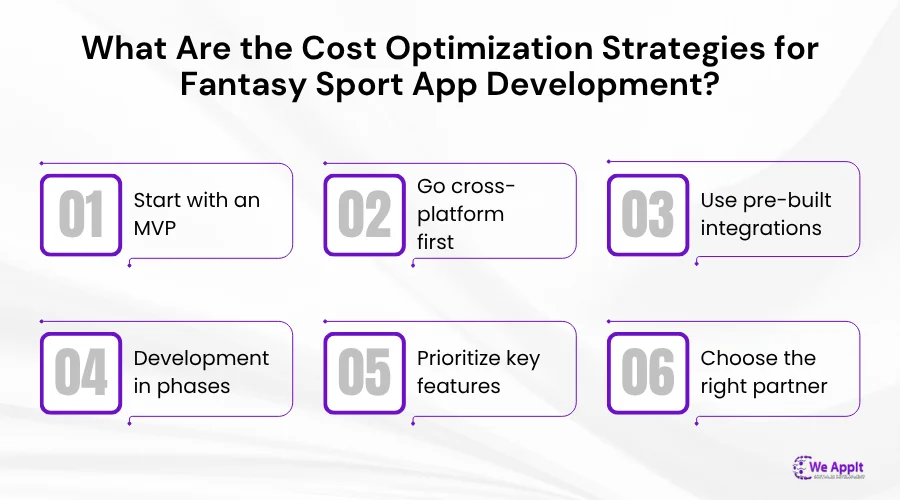
To optimize the cost to develop fantasy sports mobile apps, you have to follow the strategies below:
- Start with an MVP
- Go cross-platform first
- Use pre-built integrations
- Development in phases
- Prioritize key features
- Choose the right partner
You do not have to spend a huge amount of money to make a fantasy sports app. Let’s have a look at how smart founders keep costs under control without sacrificing quality:
1. Begin with an MVP
You should develop only the core features for your first fantasy sports app launch. After that, test it with real users and collect their valuable feedback. Then build what they actually want and not what you assumed they would want. This alone can reduce your initial cost to create a fantasy sports app by 40–60%.
2. Go Cross-Platform First
You can leverage Flutter or React Native with a single codebase for two platforms. Additionally, you get Android and iOS users for roughly the cost of creating one native application. Just save native development for version 2.0.
3. Use Pre-Built Integration
Do not develop the payment system from scratch when Stripe already exists. Also, do not create a notification system from scratch when Firebase manages it perfectly. You can pay fantasy sports app developers to connect these tools and not reinvent them. It saves your weeks of development time.
4. Develop in Phases
Do not try to develop a full-fledged fantasy sports app in the beginning. Instead, you should structure your investment in stages, like:
- Phase 1: MVP: Core functionality, one sport, basic user interface – $25,000-$50,000.
- Phase 2: Growth: Real-time data, payment gateway, multi-sport, visually appealing UI – $20,000 – $60,000.
- Phase 3: Scale: AI features, DFS, advanced analytics, community features – $20,000 – $40,000.
This agile development approach spreads cost over time and allows you to validate each phase before spending more.
5. Choose the Right Development Partner
Choosing the right fantasy sport app development team is very important for a successful project. A quality mid-sized agency, with proven experience, a strong portfolio, and transparent pricing, can deliver excellent outcomes at a price that is a fraction of hiring a top senior team.
Examine them very carefully and ask for case studies. You can also consult their prior clients who have worked with them. Just check out their mobile apps or projects they have delivered.
6. Prioritize Essential Features
To optimize the cost to develop a fantasy sports app, you should prioritise core features for the first version. Do not say yes to every feature, just ask one question: will this actually help users sign up, stay engaged?
If the answer is no, just cut that feature off from the first version. You can integrate that feature later when real usage data tells you it matters.
What Are the Monetization Models that Affect the Cost to Develop Fantasy Sports Apps?
How you plan to make money directly changes what you need to build, and therefore, your development cost. According to Mordor Intelligence, entry-fee contests accounted for 61.02% of fantasy sports market revenue in 2025. That is the dominant model in the USA, and it is also the most complex to build. Take a look at the below monetization model that affects the cost.
| Monetization Model | How it works | Additional features needed | Cost impact |
| Entry fees (pain contests) | Users pay to join a contest. Winners take the prize pool | Payment gateway, escrow system, secure payouts, KYC | High |
| Freemium + premium | Free to play, pay for exclusive contests and features | Subscription billing, tiered access control. | Medium |
| In-App Advertising | Show ads to free users | Ad SDK integration (Google AdMob, etc.) | Low |
| Sponsored contests | Brands pay to sponsor a contest with prizes | Admin tools for sponsor management, branded contests pages | Medium |
| In-app purchases | Sell virtual cons, power-ups, or lineup boosts | Virtual economy system, purchase history, and balance management. | Medium – high |
| Referral/Affiliate program | Users earn rewards for bringing in new users | Referral tracking, automated rewards system | Low-medium |
Many popular fantasy sports mobile apps combine two or three of these monetization models. You can start with the one that makes the most sense for your audience and build the others in as you grow.
How We AppIt Right Can Help You Build a Fantasy Sports App Within Your Budget?
At We AppIt Right, we have helped entrepreneurs and businesses from “I have a fantasy sports idea” to “my app is live and growing”. We are the among the top fantasy sports app development companies that offers services without the stress of surprise costs, missed deadlines, and apps that fall apart after launch.
Being a trusted fantasy sports app development company, we understand what founders actually need. A good product, a realistic budget, clear communication, and a team that actually delivers. Here is what working with us actually looks like:
- Free Strategy Call: We always begin by understanding your vision, your target audience, and your budget. Without any pressure, just an honest conversation about what is possible and what it will cost.
- Clear & Transparent Estimate: Before our developers start the development, you get a cost breakdown. You know exactly where all the money goes and why.
- Phased Development Approach: We develop your custom fantasy sports app in smart stages. You launch faster, learn from real users, and invest in the next phase only when you are ready.
- Full Stack Team Under One Roof: UI/UX design, frontend, backend, API integration, payment setup, QA, and post-launch support, all managed by one team that communicates clearly throughout the process.
- Post-launch Support: We do not just disappear after your project is launched. Our team stays with you for updates, bug fixes, scaling, and new feature development as your user base grows.
No matter if you want an MVP to test the idea in the market or a full-fledged fantasy sports app, we build it right, on budget, and deliver on time. Ready to get started? Let’s talk today!
Conclusion
Now you already have a clear idea about the cost to develop a fantasy sports app. But the biggest factors that move the above cost are the features you want, platform choice, compliance requirements, and development team.
The smartest move for most founders? Just start with a focused MVP and launch it. Besides, learn from real users, then invest in the features that actually matter to your audience.
The fantasy sports market is huge, growing fast, and full of opportunity. But the difference between a successful app and an expensive failure usually comes down to planning, the right partner, and making smart decisions.
Thus, if you are ready to take the next step, We AppIt Right is here to help you do it right. Just consult with our team and get a free cost estimate!
FAQs
To create a fantasy sports mobile application, follow the steps below:
- Conduct proper market research
- Create a core features list
- Choose the technology stack
- Create the UI/UX design
- Develop the MVP application
- Test and launch the app

Ravi is an SEO Expert at We AppIt Right, specializing in crafting data-driven strategies that enhance search visibility and drive sustainable growth. With strong expertise in technical SEO and search algorithms, he ensures every digital presence is optimized for performance and long-term success. Passionate about innovation, Ravi continuously explores emerging SEO trends like AEO, GEO and analytical techniques, staying ahead of industry changes to deliver impactful results.



No Comments
Comments are closed.