
Table of Contents
Key Takeaways:
- A fantasy sports app allows users to create virtual teams using real players and earn points based on live match performance. Popular apps include DraftKings, ESPN Fantasy, and Sleeper.
- The core features of a fantasy sports app include live drafts, real-time scoring, player stats, team management, league tools, secure payments, and leaderboards.
- Daily Fantasy Sports (DFS) apps focus on fast contests and payments, while season-long fantasy apps focus more on leagues, trades, and long-term team management.
- Advanced fantasy sports app features like AI player recommendations, injury alerts, predictive analytics, and smart auto-draft tools help improve user engagement.
- The cost to build a fantasy sports app can range from $25,000 to $250,000+ depending on features, real-time infrastructure, AI tools, and multi-sport support.
- A successful fantasy sports app development starts with strong core features first, then grows with advanced features based on user demand and market trends.
What features of fantasy sports apps actually matter, and which ones are optional? That is the question most founders get wrong.
The global fantasy sports market hit $38.50 billion in 2025. It is expected to reach $137.81 billion by 2035. Every week, millions of users open apps like DraftKings, FanDuel, ESPN, and Sleeper to draft players, track scores, and compete for prizes.
But here is the problem. Most people building a fantasy sports app spend a budget on features users do not care about and skip the ones that actually drive retention. The result is an app that looks fine but bleeds users after week one.
Before getting into the full breakdown, here is what most startup founders and product teams want answered first:
- What features does a fantasy sports app need to launch?
- Which features are must-have for MVP and which can wait?
- What role does AI play in modern fantasy sports platforms?
- How much does it cost to build a fantasy sports app with the right features?
These questions come up at every stage, from founders writing their first product brief to CTOs deciding what to cut from scope. The right answers depend on your app type, target users, and long-term goals.
This blog breaks down the most important fantasy sports app features, what you should build first, what can wait, and how to create a platform users actually keep coming back to.
What is a Fantasy Sports App?
A fantasy sports app is a platform where users choose real players to form virtual teams and earn points based on their performance. Users compete against others in leagues or open contests. Top examples are DraftKings, ESPN Fantasy, and Sleeper.
Fantasy sports started as office spreadsheet games in the 1980s. Today, they are billion-dollar mobile platforms with real-money prizes, AI recommendations, and live data feeds.
There are two main types of fantasy sports platforms:
| Type | How It Works | Example Apps |
| Season-Long Fantasy | Draft a team at season start. Manage it weekly for months. | ESPN Fantasy, Sleeper, Yahoo Fantasy |
| Daily Fantasy Sports | Build a new team each day or week. Compete in cash contests. | DraftKings, FanDuel |
Read on: If you want to add advanced features to your fantasy sports platform, check out our fantasy prediction market software development solutions.
What Are the Must-Have Features of a Fantasy Sports apps?
The must-have features of fantasy sports apps are user registration and profiles, live draft room, real-time scoring, player stats dashboard, team and roster management, etc. These features form the foundation of any fantasy sports platform. If your app is missing any of these, users will find a competitor that has them.
Let’s have a look at the basic features of fantasy sports apps.
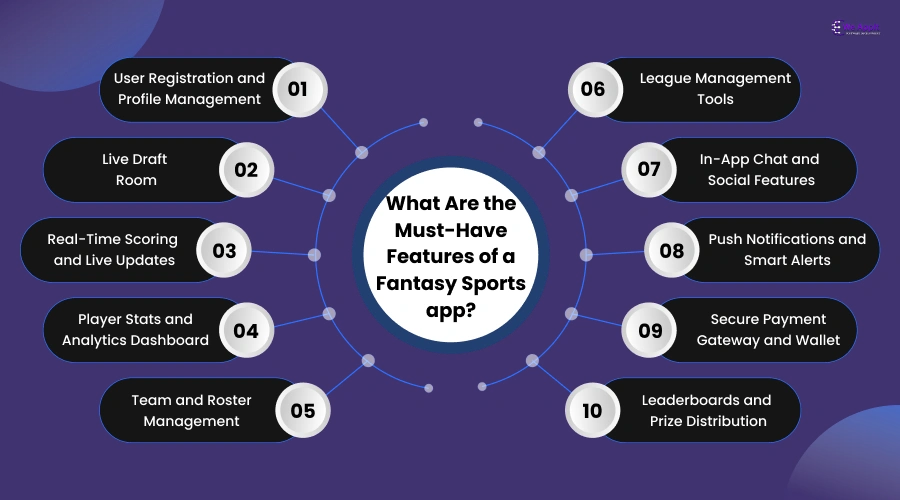
► User Registration and Profile Management
Users need to create accounts, set up profiles, and link their preferences quickly. Most people abandon apps that take more than two minutes to sign up. It allows users to manage multiple teams and leagues from one dashboard.
► Live Draft Room
Many startup founders have a question in mind. What is a draft room feature in fantasy sports?
A draft room is the real-time interface where users pick players for their team. It runs on a countdown timer, shows all available players, tracks picks made by other participants, and updates instantly as selections happen. It is the most critical interactive moment in the app. If it lags or crashes, users leave and do not come back.
► Real-Time Scoring and Live Updates
The app connects to official sports data providers and pulls live game stats. When a player scores a touchdown or hits a home run, the app calculates fantasy points and updates the leaderboard within seconds.
► Player Stats and Analytics Dashboard
Users make better decisions when they have data. A stats dashboard shows player history, recent form, injury status, and matchup data. Great apps visualize trends and highlight key stats that matter for fantasy decisions. This is where your app can stand out from simpler competitors.
► Team and Roster Management
Users need to add, drop, and trade players throughout a season or contest. Roster management feature allows users to set lineups, handle injured players, and manage waiver wire picks. This is a daily-use feature. It needs to be simple and fast. A confusing roster screen loses users fast.
► League Management Tools
Fantasy sports is a social experience. League management tools let users create private leagues, set custom rules, invite friends, manage trades, and run live commissioner controls. Fantasy sports app league management should support both public and private leagues, custom scoring settings, and automated trade reviews.
► In-App Chat and Social Features
In-app chat keeps engagement alive between games. You can add league-wide chat, trade negotiation threads, and player reaction tools.
Apps with social integration see up to 30% higher user retention compared to apps without it. Besides, fantasy sports app UI/UX should treat social features as a core product, not a nice-to-have add-on.
► Push Notifications and Smart Alerts
Fantasy sports apps use push notifications to keep users active. Alerts for injured players, waiver wire pickups, scoring updates, and contest start times all drive daily engagement. The best apps send smart, personalized alerts.
► Secure Payment Gateway and Wallet
For real-money DFS apps, a reliable fantasy sports app payment gateway is non-negotiable. Users need to deposit, withdraw, and manage their wallet inside the app. All transactions must be encrypted and PCI-DSS compliant.
► Leaderboards and Prize Distribution
Leaderboards show users where they stand. Prize distribution handles payouts for winners, automatically, transparently, and accurately. Users care deeply about both. Any error in payout calculations is a crisis.
| Pro Tip: You should choose the DFS app development companies and get these ten features integrated before you build a fantasy sports app like DFS. A polished MVP with all ten will outperform a bloated app with twenty half-built features. |
Advanced Fantasy Sports App Features To Stand Out
The advanced features of a fantasy sports app are AI-powered player recommendations, predictive analytics and injury alerts, an auto-draft assistant, a personalized news feed, and multi-sport support. These features are not needed for a basic MVP but are what separates good apps from great ones.
Once your key fantasy sports app features are solid, these advanced features give users reasons to stay and pay for premium access.
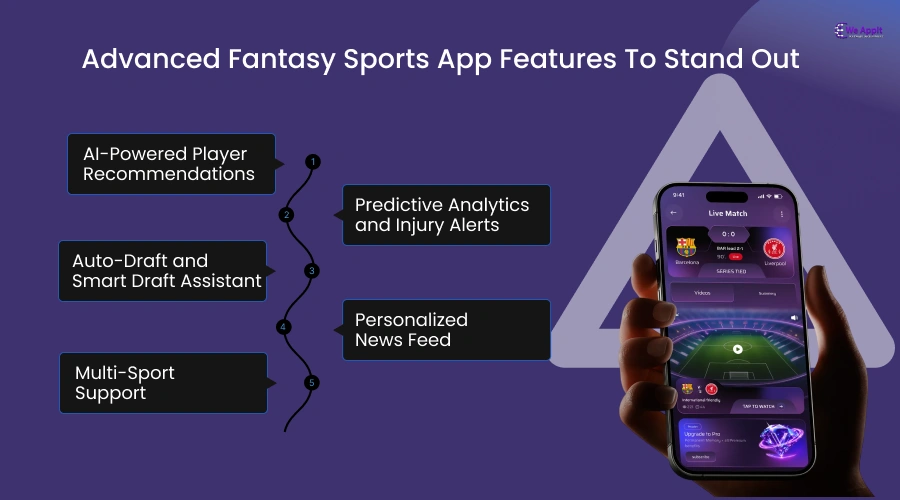
➤ AI-Powered Player Recommendations
Startup founders often ask. What AI features should they add to a fantasy sports app? You can add AI-powered lineup recommendations, predictive performance analytics, injury risk alerts, an auto-draft assistant, and a personalized news feed.
AI in fantasy sports apps analyzes hundreds of data points per player and suggests lineup changes.
➤ Predictive Analytics and Injury Alerts
It uses past data to forecast performance. Injury alerts flag real-time updates from official sources so users can act before kickoff. These two features reduce lineup errors and make users feel like they have an edge.
➤ Auto-Draft and Smart Draft Assistant
Not every year can users attend a live draft. Auto-draft allows the system to choose for them based on a ranked queue. A smart draft assistant takes it further. It evaluates available players in real time and makes picks based on team needs.
➤ Personalized News Feed
A personalized feed shows users only the content that affects their team. This keeps users in the app instead of visiting external sites. This keeps users in the app longer and reduces the need to visit external sites.
➤ Multi-Sport Support
Multi-sport support increases your addressable audience significantly without rebuilding the core of the app. Plan your architecture to support multiple sports from day one, even if you launch with just one.
Must-Have vs. Nice-to-Have: Feature Priority Comparison
Not every advanced or core fantasy sports app feature deserves the same budget and timeline.
Here is how to prioritize based on what you have to spend:
| Feature | Priority | $25K–$70K MVP | $70K–$150K | $150K–$250K+ |
| User Registration | Essential | Include | Include | Include |
| Live Draft Room | Essential | Include | Include | Include |
| Real-Time Scoring | Essential | Include | Include | Include |
| Player Stats Dashboard | Essential | Basic version | Include | Full advanced |
| Team Management | Essential | Include | Include | Include |
| League Management | Essential | Include | Include | Include |
| In-App Chat | Essential | Basic chat | Full social | Full social |
| Push Notifications | Essential | Basic alerts | Smart alerts | AI-personalized |
| Payment Gateway | Essential | Include | Include | Include |
| Leaderboards | Essential | Include | Include | Include |
| AI Recommendations | Advanced | Skip | Partial | Full AI suite |
| Trade Analyzer | Advanced | Skip | Include | Include |
| Multi-Sport Support | Advanced | Skip | 1–2 sports | Full multi-sport |
| Personalized Feed | Advanced | Skip | Skip | Include |
You should ship a focused MVP and get real users. Then build the next layer based on what your audience actually asks for, not what you assume they want. The apps that fail are the ones that spent two years building features nobody asked for.
Daily Fantasy Sports vs. Season-Long Fantasy: Which Features Differ?
Season-long fantasy apps need best league management, roster tools, and trade systems. Daily fantasy sports apps need fast contest creation, a secure payment gateway, anti-fraud systems, and quick lineup entry. DFS apps like DraftKings and FanDuel require more robust real-time data and payment infrastructure than season-long platforms. Your app type determines your feature priorities.
Here is a quick breakdown:
| Feature Area | Season-Long Fantasy | Daily Fantasy Sports (DFS) |
| League Management | Critical | Minimal |
| Trade Tools | Critical | Not needed |
| Payment Gateway | Basic (optional) | Critical |
| Contest Creation | Simple | Advanced |
| Real-Time Scoring | Important | Critical |
| Anti-Fraud Systems | Basic | Critical |
| Roster Management | Weekly | Daily |
How Much Does It Cost to Build a Fantasy Sports App?
The cost to develop a fantasy sports app can range between $25,000-$250,000+. It depends on the features of a fantasy sports app, complexity, platform choice, and team size. However, fantasy sports app development cost and features are directly linked.
Take a look at the realistic cost breakdown.
| Budget range | What you can build | Estimated timeline |
| $25,000 – $70,000 | MVP with 10 core features, one sport, and basic UI | 2 – 4 months |
| $70,000 – $150,000 | Full platform, trade tools, partial AI, 2-3 sports | 4 – 7 months |
| $150,000 – $250,000+ | Full AI suite, multi-sport, real-money DFS, scalable infra | 7 – 9 months |
The biggest cost driver is not the feature count. It is real-time infrastructure. Live data API licensing, cloud setup, and payment compliance all add costs that many startup founders underestimate. You must budget at least 30-40% extra as a buffer on top of your initial estimate.
Why Choose We AppIt Right to Develop a Fantasy Sports App?
We AppIt Right is a full-cycle fantasy sports app development company with hands-on experience in creating sports, gaming, and entertainment platforms. We also support custom features based on business needs.
This includes player drafting, live contests, reward systems, leaderboards, referral programs, and admin panels.
We have helped startups, media companies, and sports organizations build fantasy sports apps from concept to a real, working product. We do not oversell, and we do not disappear after launch. If you are ready to go from idea to app, we are ready to talk.
If you are planning to build a fantasy sports app that users actually enjoy using, not just another copy of existing platforms, We AppIt Right can help you turn the idea into a working product with the right technology, features, and long-term support.
Conclusion
The fantasy sports market is growing fast. The window to build a fantasy sports app is open right now, but it will not stay open forever.
You now know the best core features of fantasy sports apps, advanced fantasy sports app features that separate good apps from great ones, how to prioritize your build based on budget, and what it realistically costs to get there.
The next step is yours. If you are already turning an idea into a real product, we are ready to help, from your first conversation to a fully launched, market-ready app.
FAQs

We AppIt Right is a mobile app and web development company in the USA. As one of the top development companies, we offer a range of innovative services that help businesses around the world grow and reach their top potential. Our services range from iPhone app development, hybrid app development, to front-end designing, and maintenance services.



No Comments
Comments are closed.