
Table of Contents
Key Takeaways:
- Choose a fantasy sports app tech stack based on your app’s format, features, and scalability needs.
- React Native and Flutter support faster cross-platform mobile development.
- Node.js, Python, PostgreSQL, MongoDB, and Redis support core app functionality.
- WebSockets and sports data APIs enable live scores and real-time updates.
- Cloud services, Kubernetes, and auto-scaling help manage traffic spikes.
- Security, payments, geofencing, and compliance are essential for real-money fantasy apps.
- Connect with We AppIt Right, to build the complete tech stack for fantasy sports app.
Are you building your fantasy sports app, but confused about the tech stack?
If yes, then you are at the right place.
From the frontend, backend, database systems, cloud infrastructure, sports data APIs, payment gateways, and the compliance tools, every tech stack selection matters.
In this guide, we will walk you through the right tech stack model from frontend, backend, database layer, real-time scoring architecture, third-party sports data, cloud, DevOps, and even cost.
Lets begin, together.
What is a Fantasy Sports App Tech Stack?
A fantasy sports app tech Stack is the complete combination of programming languages, frameworks, databases, along with cloud services to create a complete fantasy sports platform.
Most of the fantasy sports startups and entrepreneurs often ask, “What is the best tech stack for a fantasy sports app?”
A tech stack is a combination of different layers such as frontend, backend, database, real-time layer, and cloud integrations.
When you start a fantasy sports app business, one of the important criteria to look is “tech stack”.
But why the right tech stack matters: well, there are multiple reasons; let’s get ahead with all of them in the next section.
Why the Right Tech Stack Matters?
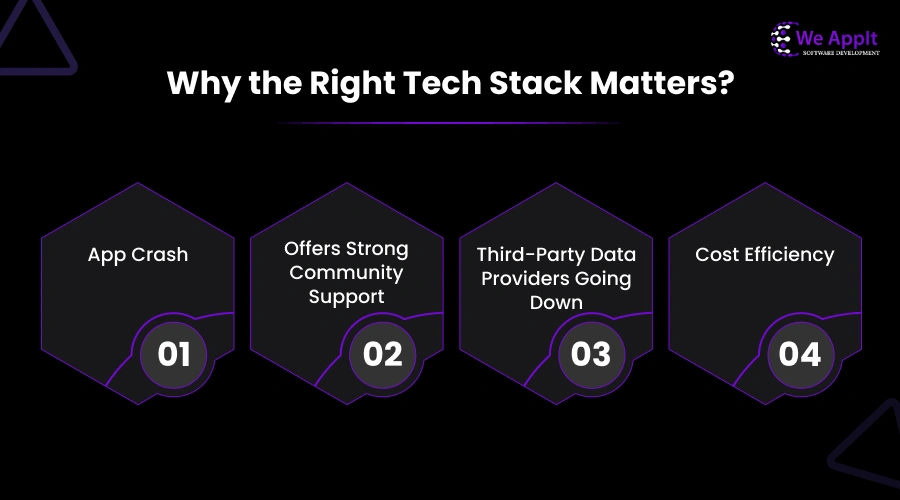
There are different reasons why the right tech stack matters, such as an app lagging or crashing during live streaming, scalability of the app, traffic spikes during the session or league, and odds and payout processing failures.
Let’s understand and know the reasons in detail:
1. App Crash
When the software stops working due to a traffic increase or any internal tech failure, it is the ultimate sign that a tech stack cannot handle underlying memory limits and system errors.
2. Offers Strong Community Support
The right tech stack matters because it offers strong community support. These technologies have active developer communities that patch security issues and patch security bugs.
3. Third-Party Data Providers Going Down
Another crucial reason is that third-party sports data providers are going down or require an emergency mid-project switch. These third-party providers are driven by a shift in the digital ecosystem toward user privacy and browser restrictions.
4. Cost Efficiency
If your fantasy sports app has the right tech stack, it will naturally improve cost efficiency, as widely adopted technologies make it easier and cheaper to hire developers and scale infrastructure over time.
Now, let’s get ahead with the right tech stack layers that you need to uncover while selecting a tech stack for your fantasy sports app.
Frontend Layer: Building the User Experience
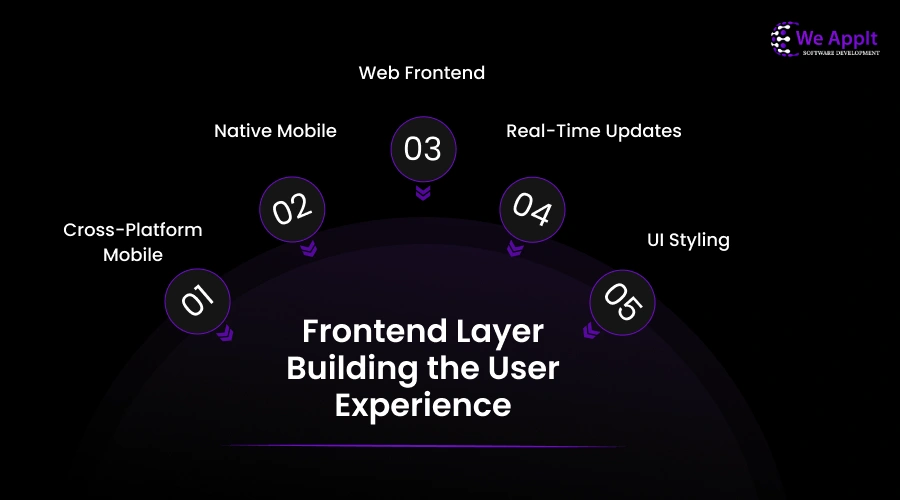
The frontend layer of a fantasy sports app tech stack includes cross-platform technologies, react native, Flutter. Native mobile technologies such as Swift (iOS) and Kotlin (Android), and web frontend tech such as React.js and Next.js.
Here is the complete list of technologies to include while creating the frontend layer of your fintech app:
| Category | Technology | Purpose |
| Cross-Platform Mobile | React Native, Flutter | Single codebase for iOS + Android |
| Native Mobile | Swift (iOS), Kotlin (Android) | High-performance, native-grade apps |
| Web Frontend | React.js / Next.js | Web app, dashboards, drafting UI |
| Core Languages | HTML5, CSS3, JavaScript/TypeScript | Foundation markup & logic |
| Real-Time Updates | WebSockets / Socket.IO client | Live scores, drafts, notifications |
| UI Styling | Tailwind CSS / Material UI | Fast, consistent, responsive design |
| Push Notifications | Firebase Cloud Messaging (FCM) | Alerts for scores, draft turns, results |
♦ Cross-Platform Mobile
The key technologies to use in cross-platform mobile are React Native and Flutter; both of these technologies allow you to build for iOS and Android using a single codebase.
♦ Native Mobile
To power a native or cross-platform mobile frontend for a fantasy sports app, you require a high-performance backend capable of handling real-time score updates, along with secure payments.
♦ Web Frontend
With the help of web frontend technologies such as React.js and Next.js, you can create high-performance apps with interactive interfaces.
♦ Core Languages
The core languages to use in building the right tech stack are HTML5, CSS3, TypeScript, and JavaScript.
♦ Real-Time Updates
Real-time technologies like WebSockets and Socket.IO eliminate repetitive polling and are used for live scores and draft notifications.
♦ UI Styling
UI Styling is the visual layer of the frontend tech stack that helps to turn the raw sports data into an engaging and easy-to-use fantasy sports app.
When you select the fantasy sports app features, complying with the right tech stack matters, as for building the right features you need prompt technologies.
Following this frontend layer, let’s concentrate on the right backend layer to use while selecting the right fantasy sports app tech stack in the next section.
Backend Layer: Powering Game Logic & Scoring
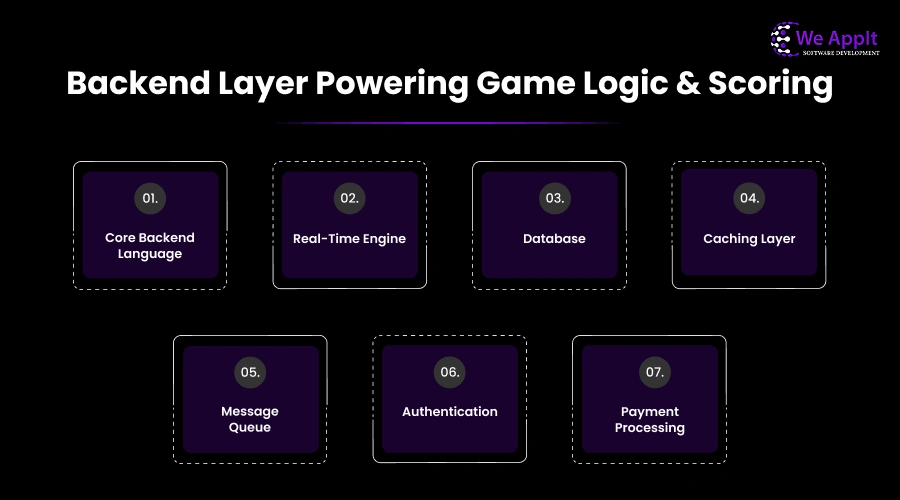
The complete backend layer of a fantasy sports app tech stack includes the core business logic, real-time scoring engines, database management, along with the third-party integrations that can handle high traffic during live games.
Here is the complete list of the backend technologies to implement and adopt:
| Category | Technology | Purpose |
| Core Backend Language | Node.js / Python (Django) | Handles game logic, APIs, and business rules |
| Real-Time Engine | Socket.IO / WebSockets | Powers live scoring, drafts & notifications |
| Database (Relational) | PostgreSQL / MySQL | Stores users, leagues, transactions |
| Database (NoSQL) | MongoDB | Handles high-write player & live event data |
| Caching Layer | Redis | Speeds up leaderboards & session data |
| Message Queue | Apache Kafka / RabbitMQ | Manages high-traffic, event-driven data at scale |
| Authentication | JWT / OAuth 2.0 | Secures user login & sessions |
| Payment Processing | Stripe / Razorpay | Handles entry fees & payouts |
► Core Backend Language
Here, the key technologies that you should include are Node.js and Python. Furthermore, the technologies comprise C++, C#, Go (Golang), along with Node.js.
► Real-Time Engine
The key real-time engine that helps in building the backend of a fantasy sports app tech stack is keeping a single connection open so servers can push instant updates to users without worrying about any type of request.
► Database
MongoDB is a flexible, document-based NoSQL database that helps simplify the overall backend layer by storing data. It typically combines a relational database such as PostgreSQL and MySQL that combines the relational database with an in-memory store.
► Caching Layer
A caching layer acts as a high-speed, temporary data store between your app servers and the primary database for handling heavy traffic and delivering instant updates.
► Message Queue
A message queue acts as an immediate storage buffer that helps the backend services to communicate and even process tasks asynchronously.
► Authentication
Authentication confirms who the user is and further acts as the foundational security layer for your backend architecture.
► Payment Processing
Payment processing technologies such as Stripe and Razorpay offer a secure transactional engine, compliance framework, as well as financial state management.
Database Layer and Real-Time Scoring Architecture
When it comes to the database layer and a real-time scoring architecture, you should note that both work simultaneously. Both these technologies form the high-speed engine of a fantasy sports app backend.
Before you switch to the tables, evaluating the key relationships between the software apps and databases is effective for managing the complete data.
Let’s study both the technological layers in the following tables:
Database Technologies
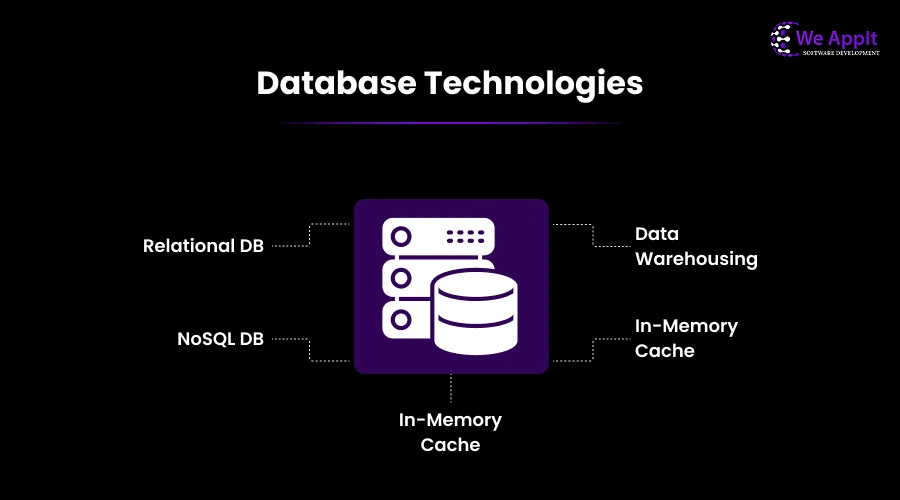
| Category | Technology | Purpose |
| Relational DB | PostgreSQL / MySQL | Users, leagues, transactions, structured data |
| NoSQL DB | MongoDB | Live player stats & high-write event data |
| In-Memory Cache | Redis | Fast leaderboard & session lookups |
| Time-Series DB | InfluxDB / TimescaleDB | Tracks historical scoring & performance trends |
| Data Warehouse | BigQuery / Redshift | Analytics & long-term reporting |
➤ Relational DB
The key technologies to include in the relational DB are PostgreSQL and MySQL. These databases are backed by migration and even connection management tools.
➤ NoSQL DB
NoSQL DB serves as the foundational database layer because traditional relational databases struggle to handle the high-velocity demands of the users.
➤ In-Memory Cache
When it comes to the in-memory cache, your app needs to be fast and impressive. You should note that most slow apps aren’t slow because of their poor design; they perform slowly because of In-memory caching. This database cuts the time for fetching the data, that makes app faster.
➤ Time-Series DB
A time series DB is a specialized data management system that is optimized for tracking changes over continuous intervals, treating timestamps as a primary index. Two forms of time series data that can be included in fantasy sports app are regular and irregular time series.
➤ Data Warehousing
Another fantasy sports app tech stack is data warehousing. Building a fantasy sports app requires tracking millions of data points, including the live player stats, user drafts and scoring updates.
Well, to build a fantasy sports app, another crucial segment to look is real-time scoring architecture.
Real-Time Scoring Architecture
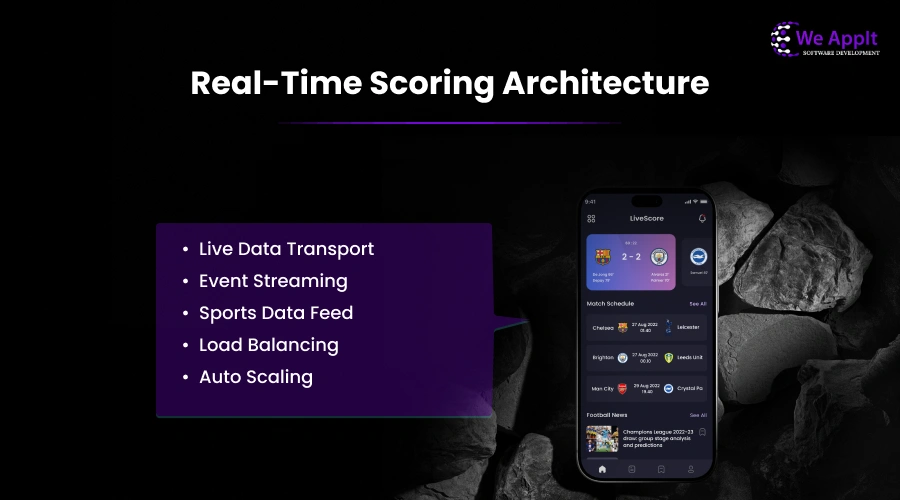
| Category | Technology | Purpose |
| Live Data Transport | WebSockets / Socket.IO | Pushes instant score & draft updates |
| Event Streaming | Apache Kafka | Handles high-volume, low-latency scoring events |
| Sports Data Feed | Sportradar / Genius Sports API | Supplies real-time player & match stats |
| Load Balancing | NGINX / AWS ELB | Distributes traffic during game-day spikes |
| Auto-Scaling | Kubernetes / AWS Auto Scaling | Handles sudden concurrent user surges |
♦ Live Data Transport
Live data transport in the fantasy sports app tech is where you can use the webSockets, for pushing the real-time score updates, player updates and draft picks from the server to the user.
♦ Event Streaming
Event streaming functions as a real-time scoring architecture through continuously ingesting, enriching and evaluating the data events at the movement they occur. In case of the fantasy sports apps, it is the tech stack that helps users to stream live sports events.
♦ Sports Data Feed
A sports data feed functions as a real-time scoring in the fantasy sports apps via collecting the live events, and processing the player statistics via custom scoring rules.
♦ Load Balancing
Load balancing distributes the incoming traffic and score updates across different servers. And with the fantasy sports apps, a real-time scoring architecture splits the incoming score requests that offers seamless streaming for the users.
♦ Auto Scaling
Using the auto scaling as a real-time scoring architecture offers an efficient operational scope through dynamically aligning your machine learning with the fluctuating API traffic.
Another stack to count is third-party sports data and API integration that you should look for fantasy sports app tech stack.
Third-party Sports Data and API Integration
The third-party sports data and application programming integration (API) is efficient because it automates real-time data pipelines, eliminating costly manual collection while delivering the structured information instantly.
Why the third-party sports data and API integration matters:
- Offers real-time speed
- Provides operational efficiency
- Enables risk and margin control
- Risk and margin control
With the third-party integration, you offer multiple services on one platform. Furthermore, it acts as the core engine that powers the live scoring, automated point calculations, as well as real-time leaderboards.
Cloud, DevOps & Scalability
The key cloud, DevOps that you should include while selecting the fantasy sports app tech stack are AWS, Azure, and Google Cloud. While for orchestration, you need Kubernetes.
Lets check out the complete table of cloud, DevOps and Scalability in the given table:
| Category | Technology | Purpose |
| Cloud Provider | AWS / Google Cloud / Azure | Hosts app, database & backend services |
| Containerization | Docker | Packages app for consistent deployment |
| Orchestration | Kubernetes | Manages and scales containers automatically |
| Auto-Scaling | AWS Auto Scaling / GCP Autoscaler | Handles game-day traffic surges |
| Load Balancing | NGINX / AWS ELB | Distributes traffic evenly across servers |
| CI/CD Pipeline | GitHub Actions / Jenkins | Automates testing & deployment |
| Monitoring & Logging | Datadog / CloudWatch / Grafana | Tracks performance, errors & uptime |
| CDN | Cloudflare / AWS CloudFront | Speeds up content delivery globally |
Compliance & Security Tech
While creating a fantasy sports app tech stack, We AppIt Right follows the right compliances and security tech stack.
Here is the complete table stating the compliances and security tech:
| Category | Framework/Tech | Purpose |
| DFS State Compliance | Geofencing (state-by-state) | Restricts real-money play per US state law |
| Identity Verification | KYC/AML tools (e.g., Jumio, Onfido) | Verifies user identity for real-money platforms |
| Payment Security | PCI-DSS | Secures payment/entry-fee transactions |
| Data Privacy | CCPA | Protects California user data rights |
| Security Standard | SOC 2 | Validates data security & operational controls |
| Data Encryption | AES-256 / TLS 1.3 | Encrypts data at rest & in transit |
Does the Tech Stack Differ By Fantasy App Format?
Yes, your tech stack can differ by the fantasy sports app format, with the type of the fantasy sports app model selection, the selection of tech stack might vary.
Here, many startups and entrepreneurs often asks “Can the same tech stack work for DFS, season-long, and prediction-market apps?”
Well, no!
Here’s how they differ:
- Different Game Mechanics: Every fantasy sports app has a different game mechanics, on which the complete fantasy app format is based.
- Season- Long Fantasy Leagues: Drafts, roasters, trades, standings, notifications, and league chat.
- DFS Sports: Salary-cap validation, lineup locking, contest creation, and leaderboards.
- Pick’em Or Player Prop Fantasy: Pick validation, projection management , and event settlement.
- Prediction-Based Fantasy Tech Stack: The right prediction-based fantasy tech stack includes rules engines, event sourcing, and risk control frameworks. You can partner with the leading fantasy prediction market software development company for the same.
- Social or Casual fantasy: Real-time communication, NoSQL databases, and push infrastructure.
How Do Tech Stack Choices Affect the Development Cost of a Fantasy Sports App?
Tech stack directly impacts the total cost to create the fantasy sports app as selecting a specific technology stack shapes both the upfront development budget and the recurring operating expenses.
It impacts the cost, as by dictating how much engineering time, infrastructure scaling, along with the ongoing maintenance you need.
Here’s how the tech stack choices affect the overall fantasy sports app development cost:
- The types of technologies you select for your fantasy sports apps such as react native, or Next.js, have a large impact on the the cost.
- Type of cloud deployment and scalability such as hostings on the platforms.
- You should evaluate the complete hosting fees, along with the long-term maintenance overhead.
Are you searching for the right company who can help you build the backend for your complete fantasy sports app?
Well, you don’t need to go far.
Which is the Right Company to Build Complete Fantasy Sports App Tech Stack?
We AppIt Right is the best Fantasy Sports App Development Company, as it offers the end-to-end app development. Furthermore, it offers a full-cycle engineering, real-time data integration, as well as user-focused design that tailors for the sports platforms.
This is why you need to select We AppIt Right:
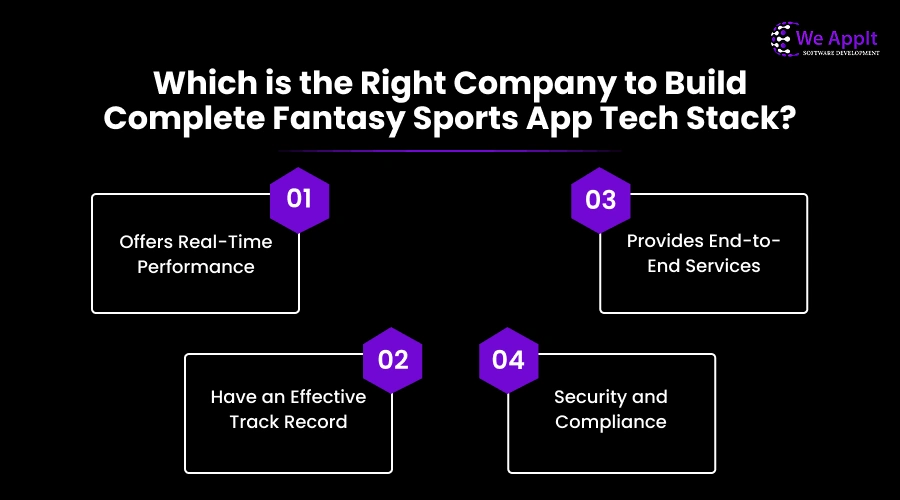
1. Offers Real-Time Performance
We AppIt Right offers real-time performance in fantasy sports through combining the low-latency communication protocols with the automated performance monitoring.
2. Have an Effective Track Record
We AppIt Right have an effective track record as it has delivered over 350+ softwares. You can gain high project volume, and industry-recognized retention rates.
3. Provides End-to-End Services
From discovery and planning, designing of the app, selecting the right tech stack, testing, deployment of an app, and further app maintenance. All of these services are offered by We AppIt Right.
4. Security and Compliance
The company offers security and compliances practices with each of the softwares and apps. The key security features that the company offers are KYC, enforcing MFAs, and managing the secrets securely.
Conclusion
Fantasy sports app tech stack is all about selecting the right tech stack that requires a combination of programming languages, frameworks, databases, along with the cloud services for building a complete fantasy sports platform.
The reason to select the right tech stack are app crash, it offers a strong community support, third-party data providers going down, and cost efficiency.
The right tech stack to include while building a fantasy sports app are cross-platform mobile, native mobile, web frontend, real-time updates, and UI styling for frontend. While backend layer comprises of real-time engine, right databases such as MangoDB, and time-series DB. Here the fantasy sports app tech stack do affects the complete cost by the nature of technologies.
FAQs
A fantasy sports app tech stack is the combination of technologies used to build and operate a fantasy platform. It typically includes frontend frameworks, backend languages, databases, real-time scoring tools, cloud services, payment systems, security tools, and third-party sports data APIs.
There is no single best tech stack for every fantasy sports app. A common combination includes React Native or Flutter for mobile development, React.js or Next.js for web applications, Node.js or Python for the backend, PostgreSQL or MySQL for structured data, MongoDB for high-volume event data, and Redis for caching.
Real-time technologies allow the platform to instantly deliver live scores, player statistics, draft updates, contest changes, and leaderboard movements. WebSockets, Socket.IO, Kafka, and sports data APIs help reduce delays and improve the user experience during live matches.
Yes, each fantasy format requires different technical capabilities. Season-long apps focus on drafts, trades, waivers, and standings, while DFS platforms need salary-cap validation, lineup locking, contests, and payouts. Pick’em apps require projection management, pick validation, event settlement, and audit-ready records.
PostgreSQL and MySQL are commonly used for structured information such as users, leagues, rosters, transactions, and contest records. MongoDB can manage flexible, high-write event data, while Redis supports fast access to sessions, player data, scores, and leaderboards.
The technology stack affects development time, developer availability, infrastructure costs, scalability, maintenance, and third-party integration expenses. Cross-platform frameworks may reduce initial development costs, while advanced real-time scoring, payment processing, compliance, and high-traffic infrastructure can increase the overall budget.

We AppIt Right is a mobile app and web development company in the USA. As one of the top development companies, we offer a range of innovative services that help businesses around the world grow and reach their top potential. Our services range from iPhone app development, hybrid app development, to front-end designing, and maintenance services.



No Comments
Comments are closed.