

Table of Contents
Key Takeaways:
- Fantasy football app development for FIFA World Cup 2026 offers a great opportunity to engage football fans during one of the biggest sporting events in the world.
- You can build different types of fantasy apps, but tournament-based and private league formats are often the best fit for the World Cup.
- A clear scoring system and smooth gameplay are essential to keep users engaged and make competitions feel fair.
- Real-time match data powers the entire experience, helping users track player performance, points, and rankings instantly.
- Features like team management, live scoring, leaderboards, and league participation form the core of a successful fantasy platform.
- Choosing the right technology helps the app handle live updates, user activity, and tournament traffic without issues.
- A good launch plan, solid monetization strategy, and legal compliance are key to turning a fantasy football app into a successful business.
If you want to create a fantasy football app for the FIFA World Cup, there has never been a bigger opportunity. FIFA World Cup 2026 kicks off in June 2026 across the United States, Canada, and Mexico, featuring 48 teams and 104 matches.
That’s 29% more matches than the 2022 tournament. More games mean more player selections, more team changes, and more opportunities to keep users engaged throughout the competition.
The timing also makes business sense. According to Grand View Research, the global fantasy sports market was valued at $24.85 billion in 2024 and is projected to reach $56.38 billion by 2030. Football continues to be one of the biggest drivers of fantasy sports participation worldwide.
Whether you are a startup founder, sports entrepreneur, fantasy sports operator, or business looking to enter the sports-tech market, understanding the development process is essential.
In this guide, we will walk you through how to develop a fantasy football app for the FIFA World Cup. Also, we will discuss the features, technology requirements, monetization strategies, development costs, and the steps needed to launch a successful platform.
What is a Fantasy Football App?
A fantasy football app allows users to pick real footballers and form a virtual team. As those players perform in actual matches, scoring goals, making assists, or keeping clean sheets, users earn points based on real match data. Additionally, users compete against others in leagues or contests, with winners determined by total points earned.
For a FIFA World Cup-specific app, each round of the tournament becomes a new contest. Users can adjust their squads, trade players, and compete in global or private leagues throughout the tournament.
Additionally, fantasy football apps like Dream11, FanDuel, and DraftKings, and the official FIFA Fantasy platform, have built entire businesses on this concept.
The difference between them and your app? You are creating one focused entirely on the World Cup, which is the single most-watched sporting event.
FIFA World Cup 2026 Match Schedule Table
The FIFA World Cup 2026 will feature 104 matches across the USA, Canada, and Mexico.
The table below provides an overview of the tournament schedule, including match dates, venues, and stages.
| S.N. | Date (ET) | Stage | Match | Venue | City / Country |
| 1 | Thu Jun 11, 15:00 | Group Stage | Mexico vs South Africa | Estadio Azteca | Mexico City, MEX |
| 2 | Thu Jun 11, 22:00 | Group Stage | South Korea vs Denmark/Czech/Ireland/N.Macedonia | Estadio Guadalajara | Zapopan, MEX |
| 3 | Fri Jun 12, 15:00 | Group Stage | Canada vs Italy/N.Ireland/Wales/Bosnia | BMO Field | Toronto, CAN |
| 4 | Fri Jun 12, 21:00 | Group Stage | USA vs Paraguay | SoFi Stadium | Los Angeles, USA |
| 5 | Sat Jun 13, 15:00 | Group Stage | Qatar vs Switzerland | Levi’s Stadium | San Francisco Bay Area, USA |
| 6 | Sat Jun 13, 18:00 | Group Stage | Brazil vs Morocco | MetLife Stadium | New York/NJ, USA |
| 7 | Sat Jun 13, 21:00 | Group Stage | Haiti vs Scotland | Gillette Stadium | Boston, USA |
| 8 | Sat Jun 13, 00:00 | Group Stage | Australia vs Turkey/Romania/Slovakia/Kosovo | BC Place | Vancouver, CAN |
| 9 | Sun Jun 14, 13:00 | Group Stage | Germany vs Curaçao | NRG Stadium | Houston, USA |
| 10 | Sun Jun 14, 16:00 | Group Stage | Netherlands vs Japan | AT&T Stadium | Dallas, USA |
| 11 | Sun Jun 14, 19:00 | Group Stage | Ivory Coast vs Ecuador | Lincoln Financial Field | Philadelphia, USA |
| 12 | Sun Jun 14, 22:00 | Group Stage | Ukraine/Sweden/Poland/Albania vs Tunisia | Estadio BBVA | Monterrey, MEX |
| 13 | Mon Jun 15, 12:00 | Group Stage | Spain vs Cape Verde | Mercedes-Benz Stadium | Atlanta, USA |
| 14 | Mon Jun 15, 15:00 | Group Stage | Belgium vs Egypt | BC Place | Vancouver, CAN |
| 15 | Mon Jun 15, 18:00 | Group Stage | Saudi Arabia vs Uruguay | Hard Rock Stadium | Miami, USA |
| 16 | Mon Jun 15, 21:00 | Group Stage | Iran vs New Zealand | SoFi Stadium | Los Angeles, USA |
| 17 | Tue Jun 16, 15:00 | Group Stage | France vs Senegal | MetLife Stadium | New York/NJ, USA |
| 18 | Tue Jun 16, 18:00 | Group Stage | Iraq/Bolivia/Suriname vs Norway | Gillette Stadium | Boston, USA |
| 19 | Tue Jun 16, 21:00 | Group Stage | Argentina vs Algeria | Arrowhead Stadium | Kansas City, USA |
| 20 | Tue Jun 16, 00:00 | Group Stage | Austria vs Jordan | Levi’s Stadium | San Francisco Bay Area, USA |
| 21 | Wed Jun 17, 13:00 | Group Stage | Portugal vs DRC/Jamaica/New Caledonia | NRG Stadium | Houston, USA |
| 22 | Wed Jun 17, 16:00 | Group Stage | England vs Croatia | AT&T Stadium | Dallas, USA |
| 23 | Wed Jun 17, 19:00 | Group Stage | Ghana vs Panama | BMO Field | Toronto, CAN |
| 24 | Wed Jun 17, 22:00 | Group Stage | Uzbekistan vs Colombia | Estadio Azteca | Mexico City, MEX |
| 25 | Thu Jun 18, 12:00 | Group Stage | Denmark/Czech/Ireland/N.Macedonia vs South Africa | Mercedes-Benz Stadium | Atlanta, USA |
| 26 | Thu Jun 18, 15:00 | Group Stage | Switzerland vs Italy/N.Ireland/Wales/Bosnia | SoFi Stadium | Los Angeles, USA |
| 27 | Thu Jun 18, 18:00 | Group Stage | Canada vs Qatar | BC Place | Vancouver, CAN |
| 28 | Thu Jun 18, 21:00 | Group Stage | Mexico vs South Korea | Estadio Guadalajara | Zapopan, MEX |
| 29 | Fri Jun 19, 15:00 | Group Stage | USA vs Australia | Lumen Field | Seattle, USA |
| 30 | Fri Jun 19, 18:00 | Group Stage | Scotland vs Morocco | Gillette Stadium | Boston, USA |
| 31 | Fri Jun 19, 21:00 | Group Stage | Brazil vs Haiti | Lincoln Financial Field | Philadelphia, USA |
| 32 | Fri Jun 19, 00:00 | Group Stage | Turkey/Romania/Slovakia/Kosovo vs Paraguay | Levi’s Stadium | San Francisco Bay Area, USA |
| 33 | Sat Jun 20, 13:00 | Group Stage | Netherlands vs Ukraine/Sweden/Poland/Albania | NRG Stadium | Houston, USA |
| 34 | Sat Jun 20, 16:00 | Group Stage | Germany vs Ivory Coast | BMO Field | Toronto, CAN |
| 35 | Sat Jun 20, 20:00 | Group Stage | Ecuador vs Curaçao | Arrowhead Stadium | Kansas City, USA |
| 36 | Sat Jun 20, 00:00 | Group Stage | Tunisia vs Japan | Estadio BBVA | Monterrey, MEX |
| 37 | Sun Jun 21, 12:00 | Group Stage | Spain vs Saudi Arabia | Mercedes-Benz Stadium | Atlanta, USA |
| 38 | Sun Jun 21, 15:00 | Group Stage | Belgium vs Iran | SoFi Stadium | Los Angeles, USA |
| 39 | Sun Jun 21, 18:00 | Group Stage | Uruguay vs Cape Verde | Hard Rock Stadium | Miami, USA |
| 40 | Sun Jun 21, 21:00 | Group Stage | New Zealand vs Egypt | BC Place | Vancouver, CAN |
| 41 | Mon Jun 22, 13:00 | Group Stage | Argentina vs Austria | AT&T Stadium | Dallas, USA |
| 42 | Mon Jun 22, 17:00 | Group Stage | France vs Iraq/Bolivia/Suriname | Lincoln Financial Field | Philadelphia, USA |
| 43 | Mon Jun 22, 20:00 | Group Stage | Norway vs Senegal | MetLife Stadium | New York/NJ, USA |
| 44 | Mon Jun 22, 23:00 | Group Stage | Jordan vs Algeria | Levi’s Stadium | San Francisco Bay Area, USA |
| 45 | Tue Jun 23, 13:00 | Group Stage | Portugal vs Uzbekistan | NRG Stadium | Houston, USA |
| 46 | Tue Jun 23, 16:00 | Group Stage | England vs Ghana | Gillette Stadium | Boston, USA |
| 47 | Tue Jun 23, 19:00 | Group Stage | Panama vs Croatia | BMO Field | Toronto, CAN |
| 48 | Tue Jun 23, 22:00 | Group Stage | Colombia vs DRC/Jamaica/New Caledonia | Estadio Guadalajara | Zapopan, MEX |
| 49 | Wed Jun 24, 15:00 | Group Stage | Switzerland vs Canada | BC Place | Vancouver, CAN |
| 50 | Wed Jun 24, 15:00 | Group Stage | Italy/N.Ireland/Wales/Bosnia vs Qatar | Lumen Field | Seattle, USA |
| 51 | Wed Jun 24, 18:00 | Group Stage | Scotland vs Brazil | Hard Rock Stadium | Miami, USA |
| 52 | Wed Jun 24, 18:00 | Group Stage | Morocco vs Haiti | Mercedes-Benz Stadium | Atlanta, USA |
| 53 | Wed Jun 24, 21:00 | Group Stage | Denmark/Czech/Ireland/N.Macedonia vs Mexico | Estadio Azteca | Mexico City, MEX |
| 54 | Wed Jun 24, 21:00 | Group Stage | South Africa vs South Korea | Estadio BBVA | Monterrey, MEX |
| 55 | Thu Jun 25, 16:00 | Group Stage | Ecuador vs Germany | MetLife Stadium | New York/NJ, USA |
| 56 | Thu Jun 25, 16:00 | Group Stage | Curaçao vs Ivory Coast | Lincoln Financial Field | Philadelphia, USA |
| 57 | Thu Jun 25, 19:00 | Group Stage | Japan vs Ukraine/Sweden/Poland/Albania | AT&T Stadium | Dallas, USA |
| 58 | Thu Jun 25, 19:00 | Group Stage | Tunisia vs Netherlands | Arrowhead Stadium | Kansas City, USA |
| 59 | Thu Jun 25, 22:00 | Group Stage | Turkey/Romania/Slovakia/Kosovo vs USA | SoFi Stadium | Los Angeles, USA |
| 60 | Thu Jun 25, 22:00 | Group Stage | Paraguay vs Australia | Levi’s Stadium | San Francisco Bay Area, USA |
| 61 | Fri Jun 26, 15:00 | Group Stage | Norway vs France | Gillette Stadium | Boston, USA |
| 62 | Fri Jun 26, 15:00 | Group Stage | Senegal vs Iraq/Bolivia/Suriname | BMO Field | Toronto, CAN |
| 63 | Fri Jun 26, 20:00 | Group Stage | Cape Verde vs Saudi Arabia | NRG Stadium | Houston, USA |
| 64 | Fri Jun 26, 20:00 | Group Stage | Uruguay vs Spain | Estadio Guadalajara | Zapopan, MEX |
| 65 | Fri Jun 26, 23:00 | Group Stage | Egypt vs Iran | Lumen Field | Seattle, USA |
| 66 | Fri Jun 26, 23:00 | Group Stage | New Zealand vs Belgium | BC Place | Vancouver, CAN |
| 67 | Sat Jun 27, 17:00 | Group Stage | Panama vs England | MetLife Stadium | New York/NJ, USA |
| 68 | Sat Jun 27, 17:00 | Group Stage | Croatia vs Ghana | Lincoln Financial Field | Philadelphia, USA |
| 69 | Sat Jun 27, 19:30 | Group Stage | Colombia vs Portugal | Hard Rock Stadium | Miami, USA |
| 70 | Sat Jun 27, 19:30 | Group Stage | DRC/Jamaica/New Caledonia vs Uzbekistan | Mercedes-Benz Stadium | Atlanta, USA |
| 71 | Sat Jun 27, 22:00 | Group Stage | Algeria vs Austria | Arrowhead Stadium | Kansas City, USA |
| 72 | Sat Jun 27, 22:00 | Group Stage | Jordan vs Argentina | AT&T Stadium | Dallas, USA |
| 73 | Sun Jun 28, 15:00 | Round of 32 | Runner-up A vs Runner-up B | SoFi Stadium | Los Angeles, USA |
| 74 | Mon Jun 29, 13:00 | Round of 32 | Winner C vs Runner-up F | NRG Stadium | Houston, USA |
| 75 | Mon Jun 29, 16:30 | Round of 32 | Winner E vs 3rd A/B/C/D/F | Gillette Stadium | Boston, USA |
| 76 | Mon Jun 29, 21:00 | Round of 32 | Winner F vs Runner-up C | Estadio BBVA | Monterrey, MEX |
| 77 | Tue Jun 30, 13:00 | Round of 32 | Runner-up E vs Runner-up I | AT&T Stadium | Dallas, USA |
| 78 | Tue Jun 30, 17:00 | Round of 32 | Winner I vs 3rd C/D/F/G/H | MetLife Stadium | New York/NJ, USA |
| 79 | Tue Jun 30, 21:00 | Round of 32 | Winner A vs 3rd C/E/F/H/I | Estadio Azteca | Mexico City, MEX |
| 80 | Wed Jul 1, 12:00 | Round of 32 | Winner L vs 3rd E/H/I/J/K | Mercedes-Benz Stadium | Atlanta, USA |
| 81 | Wed Jul 1, 16:00 | Round of 32 | Winner G vs 3rd A/E/H/I/J | Lumen Field | Seattle, USA |
| 82 | Wed Jul 1, 20:00 | Round of 32 | Winner D vs 3rd B/E/F/I/J | Levi’s Stadium | San Francisco Bay Area, USA |
| 83 | Thu Jul 2, 15:00 | Round of 32 | Winner H vs Runner-up J | SoFi Stadium | Los Angeles, USA |
| 84 | Thu Jul 2, 19:00 | Round of 32 | Runner-up K vs Runner-up L | BMO Field | Toronto, CAN |
| 85 | Thu Jul 2, 23:00 | Round of 32 | Winner B vs 3rd E/F/G/I/J | BC Place | Vancouver, CAN |
| 86 | Fri Jul 3, 14:00 | Round of 32 | Runner-up D vs Runner-up G | AT&T Stadium | Dallas, USA |
| 87 | Fri Jul 3, 18:00 | Round of 32 | Winner J vs Runner-up H | Hard Rock Stadium | Miami, USA |
| 88 | Fri Jul 3, 21:30 | Round of 32 | Winner K vs 3rd D/E/I/J/L | Arrowhead Stadium | Kansas City, USA |
| 89 | Sat Jul 4, 13:00 | Round of 16 | W73 vs W75 | NRG Stadium | Houston, USA |
| 90 | Sat Jul 4, 17:00 | Round of 16 | W74 vs W76 | Lincoln Financial Field | Philadelphia, USA |
| 91 | Sun Jul 5, 16:00 | Round of 16 | W77 vs W79 | MetLife Stadium | New York/NJ, USA |
| 92 | Sun Jul 5, 20:00 | Round of 16 | W78 vs W80 | Estadio Azteca | Mexico City, MEX |
| 93 | Mon Jul 6, 15:00 | Round of 16 | W81 vs W83 | AT&T Stadium | Dallas, USA |
| 94 | Mon Jul 6, 20:00 | Round of 16 | W82 vs W84 | Lumen Field | Seattle, USA |
| 95 | Tue Jul 7, 12:00 | Round of 16 | W85 vs W87 | Mercedes-Benz Stadium | Atlanta, USA |
| 96 | Tue Jul 7, 16:00 | Round of 16 | W86 vs W88 | BC Place | Vancouver, CAN |
| 97 | Thu Jul 9, 16:00 | Quarterfinal | QF1: W89 vs W91 | Gillette Stadium | Boston, USA |
| 98 | Fri Jul 10, 15:00 | Quarterfinal | QF2: W90 vs W92 | SoFi Stadium | Los Angeles, USA |
| 99 | Sat Jul 11, 17:00 | Quarterfinal | QF3: W93 vs W95 | Hard Rock Stadium | Miami, USA |
| 100 | Sat Jul 11, 21:00 | Quarterfinal | QF4: W94 vs W96 | Arrowhead Stadium | Kansas City, USA |
| 101 | Tue Jul 14, 15:00 | Semifinal | SF1: W97 vs W98 | AT&T Stadium | Dallas, USA |
| 102 | Wed Jul 15, 15:00 | Semifinal | SF2: W99 vs W100 | Mercedes-Benz Stadium | Atlanta, USA |
| 103 | Sat Jul 18, 17:00 | Third Place | 3rd Place: L101 vs L102 | Hard Rock Stadium | Miami, USA |
| 104 | Sun Jul 19, 15:00 | Final | World Cup Final | MetLife Stadium | New York/NJ, USA |
Why is the FIFA World Cup 2026 a Good Opportunity for Fantasy Football Apps?
FIFA World Cup 2026 spans 6 weeks, features 48 teams and 104 matches across 3 countries, and draws billions of global viewers. This creates a concentrated window of high engagement, perfect for fantasy platforms. Fans who would never join a full season league happily play for 6 weeks during the World Cup.
Here is what makes the World Cup different from, say, building a Premier League fantasy app.
- 4 billion people follow football globally.
- World Cup 2026 has 48 teams, up from 32 in 2022, giving fantasy users more player options.
- The tournament runs for 6 weeks, which keeps engagement high without the year-long fatigue of club leagues.
- Over 80% of fantasy sports users access the platform via mobile, making app-first development essential.
- North America alone has 62.5 million fantasy sports users, and the 2026 World Cup is hosted there; that is your first market.
This is not a niche opportunity. It is a defined 6-week window with a global audience already excited to participate. Platforms that launch before the tournament starts will capture the bulk of early registrations.
What Are the Types of Fantasy Football Apps You Can Build?
What types of fantasy football apps exist? There are three main types: season-long leagues, daily fantasy sports, and tournament-specific apps built around a single event like the FIFA World Cup. Tournament apps are best suited for World Cup 2026 due to the time-bound nature of the event.
Let’s take a look at the table below showcasing the different types of fantasy football applications.
| Type | How It Works | Best For |
| Season-long leagues | Users choose a squad at the start and manage it across all rounds of the tournament. | Hardcore fans who want to stay engaged for the full six weeks. |
| Daily fantasy sports (DFS) | Short contests based on one match or one round. New team each time | Higher monetization. Works well for casual users who do not want long-term commitment. |
| Tournament-specific | Designed around one event like the World Cup. Fixed start/end and clear prize structure. | FIFA World Cup 2026. This is the format that fits perfectly. |
| Private leagues | Users create their own leagues and invite friends, family, or colleagues | A social feature layered on top of any of the above formats. Boosts retention and word-of-mouth. |
For most teams building for the World Cup, the smartest move is to combine tournament-specific leagues with a private league feature. You capture both the competitive user and the casual social user in one product.
How to Create a Fantasy Football App for the FIFA World Cup?
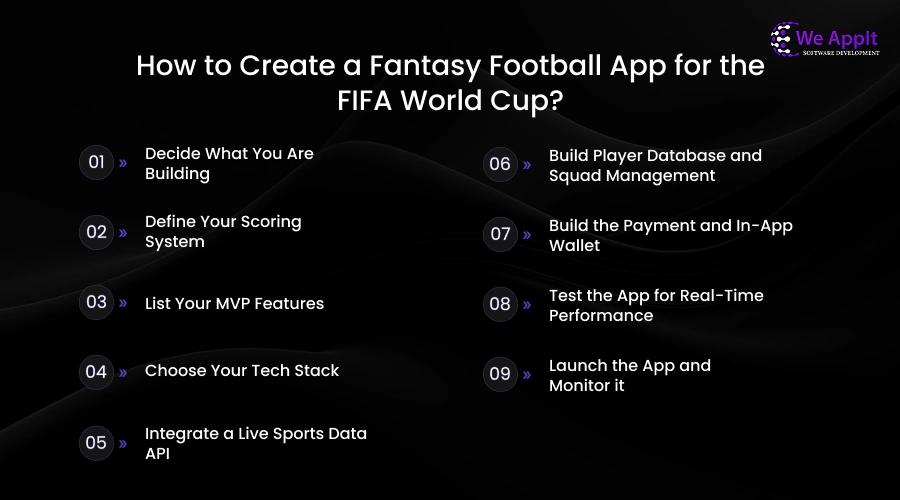
To develop a fantasy football app for the FIFA World Cup, you have to:
- Decide What You Are Building
- Define Your Scoring System
- List Your MVP Features
- Choose Your Tech Stack
- Integrate a Live Sports Data API
- Build Player Database and Squad Management
- Build the Payment and In-App Wallet
- Test the App for Real-Time Performance
- Launch the App and Monitor It
When you follow this roadmap, you will create a customized fantasy football app that boosts user retention. Let’s now deeply understand the process.
► Decide What You Are Building
Are you building a free platform to build an audience? Or a paid-contest platform to generate revenue from day one? Do you want to build DFS app solutions or season-long apps? Both are different products.
They have different legal requirements, different backend needs, and different user acquisition strategies. For FIFA World Cup 2026, the most vital starting point is a tournament-specific app with free public leagues and optional paid contests.
Free leagues lower the barrier to sign up. However, paid contests monetize your active users. You do not have to choose one or the other.
| At this stage, also decide: iOS only? Android only? Both? Web version too? Each adds cost and development time. For a first launch, React Native gives you both iOS and Android from one codebase. |
► Define Your Scoring System
The scoring system is the engine of your entire app. If you build this incorrectly, then users will feel the game is unfair and biased. But if you build it right, they will trust the platform enough to play.
A good starting point for a World Cup fantasy scoring system is:
| Match Action | Points |
| Goal scored (forward) | +6 points |
| Goal scored (midfielder) | +8 points |
| Goal scored (Defender or GK) | +10 points |
| Assist | +3 points |
| Clean sheet (GK or defender) | +4points |
| Clean sheet (Midfielder) | +1 point |
| Every 3 saves (GK) | +1 point |
| Yellow card | +1 point |
| Red card | +3 points |
| Own goal | +2 points |
| Penalty missed | +2 points |
| Playing 60+ minutes | +2 points |
Your backend scoring engine maps every live match event to this table and updates player points instantly. We cover how this works technically in the real-time scoring section.
► List Your MVP Features
You should create a list of features you need for MVP development. Your MVP needs exactly enough features to make the game playable, enjoyable, and trustworthy. For a World Cup fantasy app, you have to add the must-have features first.
We will discuss this in the next section. You can add more features after launch when you have real user data to tell you what people actually want. The goal is to be live before the FIFA World Cup 2026 starts.
► Choose Your Tech Stack
Your fantasy football app tech stack determines how fast your app loads under pressure, how well it handles 50,000 users checking scores simultaneously at minute 89 of a World Cup semi-final, and how much it costs to maintain after launch.
We cover the full recommended stack in the dedicated tech stack section below. The short version is. React Native for mobile, Nodejs for backend, WebSockets for real-time, and PostgreSQL + Redis for data.
► Integrate a Live Sports Data API
You cannot create a fantasy football app without a sports data API. The API is what feeds your app with live player stats, match events, goal scorers, cards, and final results in real-time. Without it, your scoring system has nothing to work with.
For your app, you need an API that covers all 48 teams and 1100+ players, delivers match events in under 2 seconds, and has a clear FIFA data plan. You can choose API providers like Sportmonks, Sportrader, Opta, and Entity Sport, all for World Cup data feeds.
► Build Player Database and Squad Management
Your player selection screen is the first real interaction a user has with your product. If it is slow, confusing, or missing players, then users will leave.
Every player record should include name, country, position, price, current form stats, and injury status. The selection screen should allow filtering by position, country, price range, and form. A user should be able to choose their full squad of 15 in under five minutes.
The budget cap system adds strategy. FIFA’s official 2026 platform uses a $100 million budget. Your platform can set its own number. The key is ensuring the budget forces trade-offs, so you have to think.
► Build the Payment and In-App Wallet
If you are running paid contests, you need a proper in-app wallet. Users need to deposit money, see their balance, enter contests, and withdraw winnings. Payment gateways like Stripe and PayPal integrate well with most fantasy app backends.
For markets where banking infrastructure is less reliable, you can consider local wallet integrations. Additionally, do not skip the withdrawal flow; that is the moment users decide if they trust your platform.
► Test the App for Real-Time Performance
Mobile app testing is the step most app development teams rush. Fantasy football apps face their biggest test during live matches, when thousands of users refresh scores simultaneously.
So, it is vital to run load tests that simulate match-day traffic before launch. Your real-time infrastructure must handle concurrent connections without dropping updates.
► Launch the App and Monitor it
Launch your MVP app at least 4-6 weeks before the tournament starts. This gives you time to onboard early users, fix bugs in a low-stakes environment, and build a user base before the first match.
During the tournament, push updates fast. If users are complaining that the player transfer window is confusing, fix it between matchdays. Apps that iterate fast during the tournament retain more users.
Must-have Features for Fantasy Football App Development
What features does a fantasy football app need? The must-have features are user registration and login, player selection with a budget system, team management, real-time live scoring, leaderboards, private and public leagues, in-app wallet and payments, push notifications, and an admin panel.
Let’s take a look at the must-have football fantasy app features table below:
| Must-Have features | What It Does |
| User registration and login | Email, contact number, or social login. Basic profile setup |
| Player selection | Browse and select players with a budget cap. Filter by position, country, or price |
| Team management | Set starting XL, captain, vice-captain. Make substitutions before each round. |
| Live scoring | Points update in real time as match events happen |
| Leaderboard | Global and private rankings updated after every match. |
| League management | Create or join public/private leagues. Invite friends through a link. |
| In-app notifications | Match alerts, score updates, team deadline reminders. |
| Admin panel | Manage players, contests, scoring rules, and payments. |
Advanced Features to Add in Fantasy Football App for FIFA World Cup 2026
Once you add the MVP fantasy sports app features, the advanced features can help your app grow and boost user experience.
The table below showcases the additional fantasy football app features that you can take into consideration.
| Advanced Features (Post-MVP or Higher Budget) | Why It Matters |
| AI-Powered Team Recommendations | Helps users make better team selections and stay engaged. |
| Live Match Data Integration | Delivers real-time scores, player stats, and rankings. |
| Social Leagues & Communities | Increases user interaction and retention. |
| In-App Chat & Messaging | Makes league participation more interactive and competitive. |
| Multi-Language Support | Expands the app’s reach to global FIFA fans. |
| Push Notifications & Alerts | Keeps users updated on matches, transfers, and points. |
| Advanced Analytics Dashboard | Provides deeper insights for strategic decision-making. |
| App Gamification & Achievement System | Encourages regular participation and long-term engagement. |
| AI-Powered Fraud Detection | Maintains fair play and platform trust. |
| Voice Assistant Integration | Improves accessibility and user convenience. |
| AR/VR Fan Experiences | Delivers a more immersive fantasy football experience. |
| NFT & Digital Collectibles | Adds unique fan engagement and monetization options. |
Tech Stack for Fantasy Football App Development
The best tech stack for a fantasy football app in 2026 is: React Native or Flutter for cross-platform development, Node.js for the backend, and so on.
Let’s take a glance at the tech stack table below.
| Layer | Recommended Tools |
| Frontend (Mobile) | React Native / Flutter |
| Frontend (Web) | React.js / Next.js |
| Backend | Node.js / Python (Django) |
| Database | PostgreSQL + MongoDB |
| Real-Time Engine | WebSockets / Firebase |
| Cache Layer | Redis |
| Cloud Hosting | AWS / Google Cloud |
| Payment Gateway | Stripe / Razorpay / PayPal |
| Push Notifications | Firebase Cloud Messaging |
How Much Does It Cost to Build a Fantasy Football App?
The cost to create a fantasy football app can range from $25,000-$200,000. This estimate reflects the investment required to develop a market-ready platform capable of supporting real users, handling gameplay operations, and competing in the fantasy sports industry.
The actual fantasy football app development cost can vary based on business requirements and development approach, but this is a reasonable benchmark for planning purposes.
Take a look at the table below of estimated cost to develop a fantasy sports app for football.
| App Type | Cost Range |
| Basic MVP | $25,000-$80,000 |
| Mid-range platform | $80,000-$150,000 |
| Full-featured app | $150,000-$200,000 |
Here is the timeline reality for FIFA World Cup 2026: the tournament starts in June 2026. If you have not started development yet, the window for a full-featured fantasy football app development is tight.
So, it is best to contact an experienced mobile app development company that can deliver an MVP in 12-14 weeks. That is possible, but only if you start now and scope tightly.
How To Monetize a Fantasy Football App For the FIFA World Cup 2026?
The fantasy football apps make money through contest entry fees, premium subscriptions, in-app advertising, sponsored leagues, and white-label licensing. Entry fees and subscriptions are the most reliable sources.
Let’s understand how football fantasy sports apps make money from the table below:
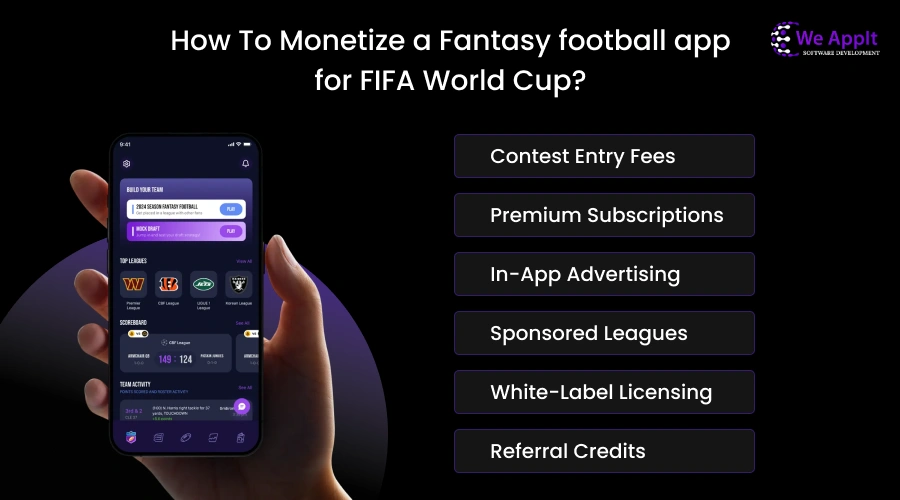
♦ Contest Entry Fees
This is the most common revenue model for fantasy sports platforms. Users pay an entry fee to participate in contests. For example, if 1,000 users each pay $1, the prize pool becomes $1,112.
The platform distributes most of the amount to winners and keeps a percentage, usually 10–20%, as its service fee. This model generates revenue every time a contest is played and forms the core income source for platforms like Dream11.
♦ Premium Subscriptions
Users pay a monthly or annual fee to access premium features. These may include advanced player statistics, AI-powered team recommendations, expert insights, injury alerts, and an ad-free experience.
Instead of relying only on contest participation, the platform earns predictable recurring revenue from loyal users who want a competitive advantage.
♦ In-App Advertising
Free users can access the platform without paying, while the platform earns money by displaying advertisements. These may include banner ads, video ads, sponsored content, or partner promotions.
Revenue is generated based on ad views, clicks, or engagement. Although earnings per user are lower than paid contests, advertising helps monetize a large free user base.
♦ Sponsored Leagues
This is the best mobile app monetization model to earn money faster. Companies pay to sponsor fantasy contests and leagues. For example, a sportswear brand could sponsor a tournament called the “Adidas Fantasy Championship.”
The sponsor gains brand visibility and user engagement, while the platform receives a sponsorship fee, revenue share, or marketing partnership income. This creates an additional revenue stream beyond user payments.
♦ White-Label Licensing
Instead of operating only its own fantasy platform, the company licenses its technology to other businesses. Sports media companies, telecom operators, betting brands, or sports organizations can launch fantasy sports products using the platform under their own branding.
The platform earns setup fees, monthly licensing charges, and ongoing maintenance revenue, often resulting in high-value contracts.
♦ Referral Credits
Users are rewarded for inviting friends to join the platform. Instead of paying cash, the platform provides in-app credits that can be used for contest entries or premium features.
This reduces customer acquisition costs, increases user growth, and encourages more contest participation, indirectly boosting platform revenue while keeping marketing expenses under control.
Legal and Compliance: What You Need to Know Before You Launch
Is it legal to run a real-money fantasy football application? Fantasy sports apps with real money are legal in many markets but heavily regulated. In the US, most states allow paid fantasy sports contests, but DFS face more scrutiny. The EU requires GDPR compliance for all user data. Any real-money platform needs KYC verification and age checks.
This is not legal advice. Every market has its own rules, and you need a qualified lawyer before you launch real-money features. What follows is a starting checklist.
Take a look:
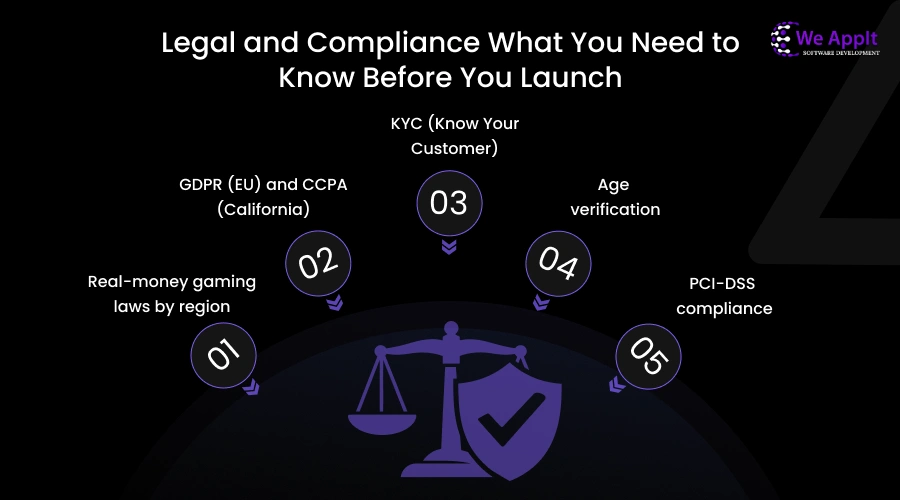
➤ Real-money gaming laws by region
You should check whether fantasy sports are classified as a game of skill or gambling in your target market. The US and UK treat fantasy sports as skill-based.
➤ GDPR (EU) and CCPA (California)
If your fantasy football application collects data from users in the EU or California, you must comply with data protection regulations like GDPR and CCPA. This means clear privacy policies, data deletion rights, and consent mechanisms.
➤ KYC (Know Your Customer)
Any platform handling withdrawals above a threshold needs identity verification. Users upload a government ID, which is verified before the first withdrawal is processed. This is non-negotiable for real-money platforms.
➤ Age verification
When you create a fantasy football app, you have to remember that it is not a minors or real-money platform. This typically means a date-of-birth check at registration and a secondary verification for withdrawal requests.
➤ PCI-DSS compliance
If you store or process credit card data, you must meet payment card industry security standards. Using an established gateway like Stripe handles most of it automatically, but you still need to understand what you are responsible for.
How Can We AppIt Right Help You Build Your Fantasy Football App?
We AppIt Right is a fantasy sports app development company that has built real-time sports platforms, fantasy products, and consumer apps that manage live data at scale. If you want to create a fantasy football app for the FIFA World Cup 2026, here is what working with us looks like.
- We start with a free strategy session to know your app type, target market, and budget.
- Our team assists you in defining the right feature set for your MVP.
- We handle the full tech stack and integrate the best sports data API for your budget.
- Our experts handle both iOS and Android development.
- We develop your in-app wallet, payment gateway, and monetization system.
We AppIt Right, work with startup founders, product teams at mid-size companies, and digital agencies that need a reliable development partner. Whether you are starting from zero or need help taking an existing product to the next level, we are here to consult you.
Conclusion
The FIFA World Cup 2026 is not just a football tournament. It is the single biggest sports event of the decade. If you want to create a fantasy football app for FIFA World Cup 2026 or have the best mobile app ideas, this is the moment to act.
It is best to decide your format and scope your MVP tightly. Choose a reliable sports data API and build a robust application. If you follow those steps and avoid the common mistakes, you have a real shot at capturing a meaningful slice of this market.
FAQs

We AppIt Right is a mobile app and web development company in the USA. As one of the top development companies, we offer a range of innovative services that help businesses around the world grow and reach their top potential. Our services range from iPhone app development, hybrid app development, to front-end designing, and maintenance services.


No Comments
Comments are closed.