
Table of Contents
Key Takeaways:
- Fantasy sports legality varies by country, state, province, and contest format; there is no single global licence.
- Paid contests may require gambling, betting, gaming, or fantasy-sports licences in specific jurisdictions.
- Startups must implement KYC, age verification, AML screening, geolocation, and responsible-gaming controls.
- Payment processing should follow PCI DSS, player-fund protection, tax, refund, and transaction-reporting requirements.
- Data protection, intellectual property, sports-data licensing, and transparent advertising are essential for lawful operations.
- Connect with We AppIt Right to create your own fantasy sports app by following all the required legal compliance for fantasy sports apps.
Launching a fantasy sports app involves more than creating engaging contests and attractive interfaces. Legal compliance for fantasy sports app platforms is essential for determining where your app can operate, how contests should be structured, and which licences may be required.
Regulations vary across countries, states, and provinces, making jurisdiction-specific research crucial for every startup.
From licensing, age verification, and game classification to payment security, data protection, intellectual property, and advertising, each area affects your platform’s legality and reputation.
Understanding these requirements can help fantasy sports startups and enterprises avoid penalties, protect users, build trust, and enter regulated markets with greater confidence and long-term stability.
Let’s begin with the same.
Is Fantasy Sports Legal?
The answer to this question depends on which country or state you are in. The legality of the fantasy sports app depends on the specific laws of each country and state.
If you check the legality of fantasy sports apps in the USA, in many states, fantasy sports apps are legal. However, this rule varies by state. The federal law is UIGEA (Unlawful Internet Gambling Enforcement Act), which has made an exception for fantasy sports apps, where these games are classified as skill-based games rather than games of luck.
However, this does not mean that fantasy sports apps are legal everywhere in the USA. This law was made to simply differentiate skill-based games from gambling.
When you start a fantasy sports app business, you should know that fantasy sports are legal in many jurisdictions, including the United States and even Europe.
To determine whether a fantasy sports platform or game format complies with the law, regulators and courts analyze different factors such as real-time data feeds, purpose of the game, game engine and scalability, user interface, secure payment gateways, and fraud detection.
Therefore, for different cities and regions, permission for fantasy sports usage and gameplay depends on the state laws and regulations.
Let’s check out the legality of fantasy sports in this section:
1. United States
The US is the largest global hub for fantasy sports apps. And when it comes to daily fantasy sports apps, these are legal in 45 out of 50 states.
If you check the fantasy sports app statistics, the United States is the leading region where the majority of people prefer to play fantasy sports.
You can find them in cities such as:
| Elements | Cities |
| Top High-Activity Cities | Denver, New Orleans, El Paso, Kansas City, New York City, Minneapolis, and Chicago. |
| Key Permitted States/ Regions | California, Texas, Florida, New York, Ohio, and Pennsylvania |
Here, most of the fantasy sports startups and entrepreneurs often ask, “Does UIGEA make my fantasy app legal in every state?“
No, only following UIGEA regulations does not make your fantasy sports app legal in all the states of the USA; you need to look at all states and regulations.
2. Canada
Fantasy sports are legal and available across all Canadian provinces and territories, but legality varies by province and territory. Here, DFS is permitted, but severe restrictions limit availability, and operators must meet AGCO requirements.
The age limit ranges from 18 to 19 years in these provinces and territories.
One of the questions that you may ask here is “Can I run one app for all provinces, or do I need separate builds?”
Yes, you can run one single app for all the Canadian provinces, and you do not need to build separate apps for each and every different province.
Here is the list of cities where fantasy sports are legal and available:
| Cities | DFS Status | What It Means for Platform |
| Ontario | Legal but restricted | Companies do need to consider the AGCO requirements. These factors are a major factor behind the DFS exodus. |
| Alberta | Legal but treated as iGaming | As per AGLC (Alberta Gaming, Liquor and Cannabis Commission), fantasy sports are classified as iGaming as they involve real-money wagering and elements of chance. |
| Quebec | Legal, along with Sports betting | Fantasy sports and even sports betting are legal in Quebec, Canada, as per the Quebec online sports betting laws. |
| Outside these three | Generally Available | Other than Ontario, Alberta, and Quebec, fantasy sports are legal in these nations. |
3. United Kingdom & Europe
Fantasy sports apps are legal in the United Kingdom and across Europe, but they are tightly regulated and split between federal exemptions with state-by-state rules in the UK and diverse national gambling frameworks in the EU.
Here, if you’re a startup and an entrepreneur going to launch your fantasy sports app, you might be wondering, “What laws apply to fantasy sports apps in the UK, Canada, and Australia?”
Fantasy sports apps are regulated as a form of gambling or pool betting in the UK and Australia, while Canada manages them via provincial gaming authorities.
Let’s check the table below to identify the solution:
| Region | States/ Jurisdictions Where DFS apps are allowed |
| United Kingdom | Allowed; however, the operators need a UK Gambling Commission licence to operate fantasy sports app businesses. |
| Other cities | Ireland, Malta, Denmark, Italy, Spain, Belgium, Bulgaria- here, fantasy sports apps are allowed but under special norms and regulations of the country. |
4. Australia & Oceania
Fantasy sports apps are legal in Australia and in Oceania, as well as the estimates suggest that there are 1.65 million fantasy sports app participants in Australia. Thus, startups that are opting for daily fantasy sports app solutions are a natural fit for the Australian market.
These are the nations and cities where fantasy sports apps are legally allowed:
| Region | Cities /Provinces | Legal Status |
| Australia | Sydney, Melbourne, Perth, Adelaide, Hobart, Canberra, and Brisbane | In all these cities, fantasy sports apps are allowed, but each state and territory follows its own regulatory association rules. |
| Outside Australia; In Oceania | Auckland, Wellington, Papua New Guinea, and Port Vila. | All the free-to-Play apps may be accessible. The real-money fantasy sports apps are regulated, and even restricted in many countries. |
5. Latin America
Latin America’s online gambling market is one of the fastest-changing and most fragmented regions globally, with countries operating under completely different legal as well as regulatory models.
Well, this map clarifies which cities, countries, and regions in Latin America fantasy sports are being played.
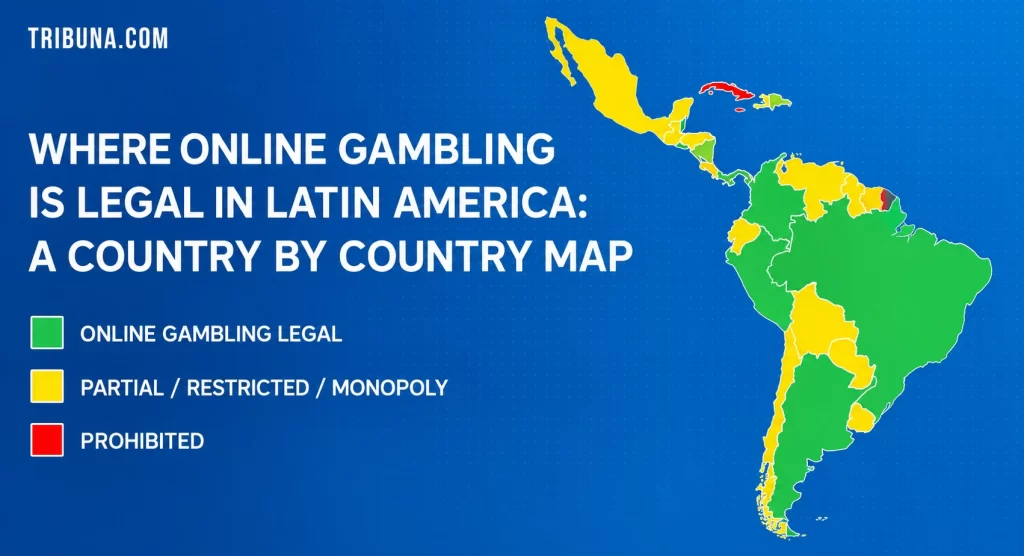
Now, following these parameters, many startups and fantasy startups often ask, “ Can I launch one fantasy sports app in multiple countries with a single legal setup?”
Well, yes, you can. By following global compliance and even cross-checking legal compliance with all the provinces, you can launch your own fantasy sports app.
But now, the question is: why is legal compliance important?
Let’s cover all of them in the next section.
Why is Legal Compliance Important For Fantasy Sports App Platforms?
There are many reasons why legal compliance matters because it prevents penalties, establishes game legality, and enables smooth market access.
Here’s what you should know about the importance of legal compliance:
- Offers Distinction from Gambling: It helps firms to have a distinction between games of skill and games of chance.
- Avoids penalties and bans: Helps to follow proper licensing by ignoring regional rules, which can lead to heavy financial penalties.
- Provides intellectual property protection: Apps use player names, logos, and even statistics. Here, securing the proper data licensing prevents copyright and even trademark infringement.
- Leads to user data security: Handling the financial transactions further results to user data security by strictly adhering to all the data protection standards to prevent cybercrimes and to create platform credibility.
- Helps in Transparent marketing: Legal compliance for fantasy sports app platforms helps to maintain transparency by preventing deceptive promotions.
What is Legal Compliance For Fantasy Sports App Platforms?
To identify the legal compliance requirements for fantasy sports app platforms, let’s begin with the global compliance requirements.
There is no single global law or license that covers fantasy sports at the global level. What follows here is the common baseline that the regulators in the US, UK, Canada, and even Australia keep converging on.
You should opt for the following compliance requirements for DFS operators:
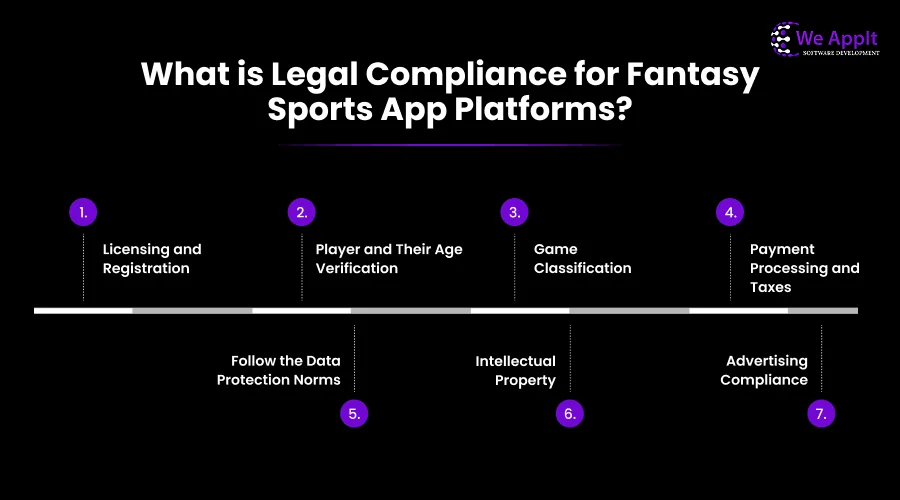
1. Licensing and Registration
When it comes to fantasy sports app legal compliance, all DFS operators should obtain a license or register with the relevant regulatory bodies.
Here, licensing requirements comprise:
- Ownership and financial details.
- Adoption of security measures such as multi-factor authentication.
- Adhering to laws such as AML and KYC.
- All responsible gaming protocols.
2. Player and Their Age Verification
It is important to consider who is logging in to your app.
Hence, follow the right procedure:
- The strict age verification processes prevent minors from participating in the game.
- Use identity verification tools to ensure that players meet the legal age requirements, often requiring government-issued identification.
- Adopt the government-issued ID verification process.
- You can use AI tools to estimate the age of the player.
3. Game Classification
Fantasy sports are classified as games of skill rather than chance to avoid gambling regulations. The UIGEA has even viewed it as a skill-based game.
- Some of the regions classify fantasy sports as a game of skill, while some of them classify it as a major part of gambling.
- Here, legal assessment for all the regions in which you are launching your game is essential.
- Following the game classification will help you to ensure that operators do not play against users and that contests require multi-player roster selections.
4. Payment Processing and Taxes
This is another consideration when you look for legal compliance for fantasy sports app platforms. The platforms handling real money should follow all the payment processing and tax legal compliance requirements for fantasy sports apps:
- Follow PCI DSS if the company processes, stores, and transmits card data.
- Opt for hosted checkout and tokenization so that the card details do not pass through the startup’s system.
- Keep the player balances and even prize funds separately accounted for where required.
- Clearly disclose entry fees, processing fees, refund rules, currency conversion charges, and any wallet-expiration policy.
5. Follow the Data Protection Norms
For the legal complinaces for fantasy sports apps, it is important to follow the data protection norms:
- Protect privacy laws such as GDPR, UK GDPR, CCPA/CCRA, and local equivalents.
- Identify user rights and withdrawal rights along with the privacy protection norms.
- Strict data minimization and robust security measures to comply with regulations.
- Follow KYC and financial security by handling real-money transactions that require strict know-your-customer and even AML protocols.
6. Intellectual Property
Intellectual property rights are a core part of legal compliance for fantasy sports platforms because these apps rely directly on protected commercial assets like player names, team logos, and even league branding.
This is what you should follow:
- To ensure legal compliance for fantasy sports apps, the developers and operators should navigate IP rights concerning copyrights, trademarks, and data usage.
- This avoids misleading associations with trademarks and brand identity, along with licensing agreements.
- Compliance with copyright and trademark laws is essential to avoid disputes. Here, using the player names, logos, and league data often requires licensing.
7. Advertising Compliance
Advertising compliance is the legal compliance for fantasy sports app platforms because the promotional content heavily influences how the regulators, app stores, and consumers classify the platform.
Here’s what you need to follow in case of advertising compliance:
- Age restrictions: The promos should explicitly state minimum age limits and should avoid targeting minors.
- No misleading claims: In the case of fantasy sports app platforms, advertisements should remain factual and transparent, strictly avoiding deceptive catchphrases and even risk-free bets.
- Responsible Gaming Prompts: Ads and responsible gaming prompts must feature explicit responsible gaming messages.
Here is the complete table stating all the compliance summary in short that must be followed:
| Compliance area | What startups must do |
| Licensing | Get a licence or registration in every market with paid contests (no global licence) |
| Legal classification | Get a legal opinion per jurisdiction that your contest format is lawful |
| KYC, age and AML | Verify identity and age, screen against sanctions lists, and monitor transactions |
| Geolocation | Block restricted regions using GPS and IP, and keep records of every check |
| Responsible gaming | Offer limits, self-exclusion, cooling-off periods and help resources |
| App store approval | Meet Apple and Google real-money rules before submitting |
| Fair play | Publish rules and prize calculations, and bar insiders from playing |
| Data privacy | Comply with GDPR or local laws, secure payment data, and report breaches (72 hours under GDPR) |
| Payments and tax | Use approved processors, segregate player funds, and handle gaming tax |
| Advertising | Never target minors, and follow local bonus and promotion rules |
| Sports data and IP | License stats, player names, and team marks (confirm with counsel) |
| Governance | Keep written policies, name a compliance officer, audit regularly, and track law changes |
Connect with We AppIt Right and Know What Legal Compliances to Follow
Partner with We AppIt Right and know what legal compliance requirements should be followed for your fantasy sports apps.
We AppIt Right is the best fantasy sports app development company that offers:
- Offers End-to-End Services: We AppIt Right offers full-cycle, end-to-end app development services where they cover every stage from the initial concept to post-launch maintenance.
- Provides Proven Experience: We AppIt Right offers proven experience, as they have launched 700+ apps that are designed to cater to diversified market requirements.
- Existing App Enhancements: Another important feature offered by We AppIt Right is legal compliance for fantasy sports app platforms, where they upgrade existing apps and even offer complete app maintenance services.
- MVP App Development: We AppIt Right offers MVP app development by creating a basic version of your app with core, essential features for testing market demand and gathering user feedback.
Conclusion
Legal compliance for fantasy sports apps helps fantasy sports startups and enterprises to prevent any kind of penalties and lawsuits; it helps to establish the game’s legality, build user trust, and offer transparency in promoting fantasy sports apps.
The core legal compliance requirements for fantasy sports apps that you need to follow are licensing and registration, player and age verification, game classification, payment processing and taxes, following data protection laws, and following advertising compliance.
If you are wondering about the legal requirements for your fantasy sports apps, you need to check with the provinces in which you are launching them.
FAQs
Yes, you can generally offer free-to-play or season-long fantasy in states where paid DFS is banned, but the contest design and state law should still be reviewed before launch.
As of September 28, 2026, October 2026 is still in the future, so its outcome cannot be relied upon. Design contests to comply with the current law in each target state and prepare for possible regulatory changes. You need to follow the compliances as per the provinces of each state for your fantasy sports apps.
This depends on the country and contest structure. In the UK, a paid league may require a Gambling Commission licence if it falls within regulated pool betting or gambling activity.
Key requirements typically include licensing, age and identity verification, AML controls, responsible-gaming measures, data protection, fair-play rules, payment security, tax compliance, and geolocation controls.
There is no single global fantasy-sports licence. You may need a gambling, betting, pool-betting, gaming, payment, or local business licence depending on the countries and states where paid contests are offered.
They may be classified as skill-based contests, gambling, betting, or a hybrid product depending on local law. Courts and regulators may also consider entry fees, prize structures, athlete performance, and the role of chance.
Compliance helps prevent fines, licence suspension, payment disruptions, app-store removal, and legal disputes. It also builds user trust and supports safer, more sustainable growth in regulated markets.

We AppIt Right is a mobile app and web development company in the USA. As one of the top development companies, we offer a range of innovative services that help businesses around the world grow and reach their top potential. Our services range from iPhone app development, hybrid app development, to front-end designing, and maintenance services.



No Comments
Comments are closed.